...observations and ramblings from a learner and traveler...

Showing posts with label Acts. Show all posts

01 January 2021

Hidden in Plain View - a lapsed argument on the New Testament's reliability

I suggest that we have such ample evidence for the reliability of these documents that we should consider ourselves privileged rather than burdened when called upon to present it. We should welcome the opportunity to reclaim and maintain the forward position held by the older apologists, for their arguments have been not so much refuted as forgotten in the shifts of theological fashion. (McGrew, 192)

 Drawing heavily on Paley's "Evidences of Christianity" and Blunt's "Scriptural Coincidences" (both free online due to their age), in Hidden in Plain View, Lydia McGrew presented a fresh and compelling argument on the historical reliability and accuracy on Scripture. Apparently this argument of (humanly) "undesigned coincidences" within Scripture  traces back to the 18th and 19th centuries, but it mostly disappeared. Now, due to a cousin's recommendation and the fact that it was available on Kindle Unlimited, I have gotten to read and benefit from this really useful book and argument. Hidden in Plain View was helpful in four areas:

1.  Reliability of Scripture (apologetics)
2.  Dealing with Bible difficulties (apologetics and hermeneutics)
3.  The 'Synoptic problem' in the Gospels (apologetics and hermeneutics)
4.  Insight into New Testament Scripture (hermeneutics)


  For the frequent reader or long-term student of the New Testament, the material in this book will probably be both extremely familiar and regularly surprising. This is particularly true of the first half, which deals with the Gospels. The reason for this is that as we have imbibed the different portions of the Scripture, we have often synthesized them in our understanding. This is obviously a good thing! However, it comes with the downside of not necessarily distinguishing the sources of the pieces of knowledge from each other. Therefore, we may not be  fully aware of many of the cases of Scripture supporting Scripture in the nitty gritty details.

  Again, this unawareness of specific links between is especially true in the four Gospel accounts, where the genres and narratives are so often read in parallel. On the other hand, I found that I was more aware of the subtle links between the accounts in Acts and the Pauline letters. I suspect that this is because each of these is more likely to be studied independently. Conversely, the Gospels, particularly the Synoptics (Matthew, Mark, Luke), are frequently studied as a whole. 

 It is in this connection that McGrew sheds light on the so-called 'synoptic problem', which she names 'the synoptic puzzle.' In fascinating details, she shows the independence of the four Gospel witnesses from each other. Most interestingly, as she points out, the details of independence often emerge at exactly the places where the accounts seem most harmonized (dependent?) at a surface level. This perspective also gives a clear response to the common question, 'Why are there four gospels (not just one)? (The apparently similar question of the later, Gnostic gospels such as the Gospel of Barnabas or the Gospel of Thomas, is quite separate actually.)

The providential provision of four Gospels gives us a three-dimensional view of the events. (p. 193)

 It was also in the Gospel sections, that I felt like there were the most significant insights into passages allowing deeper understanding of the meaning of each passage. For example, the links between John 13 where Jesus washes his followers' feet and Luke 22 where he describes servant leadership and declares, "I am among you as one who serves" are particularly poignant. The strength of this connection will certainly inform my thinking going forward.

  Anyways, this book is definitely worth reading, if not in all the details, at least to get the main argument. It is approachable in tone and, because she usually quotes the passages she is dealing with in their entirety, the argument has greater force as you see the coincidences in the details of the texts. 

  A few additional quotes to stir your interest (bold emphasis mine, italics original): 

But it is particularly noticeable that the Gospel authors often seem to write with the lack of affectation that we find in a person whose primary purpose is getting important information out there, getting down what happened, making it available, rather than in one whose primary purpose is to fit together what he writes in a polished manner. The author of the Gospel of John is certainly theological, perhaps more so than any of the other Gospel writers. But again and again we find him including items in his Gospel without their full explanations, apparently just because he wanted his readers to know that they happened. (p. 44)

What one sees in undesigned coincidences, again and again, are points which “impressed themselves upon the eye” of the spectator and came thus into the accounts we now have. (p. 63)

It’s also worth noting that any intentional connection of this miracle with the earlier miracle could, if both occurred, be attributed to Jesus himself. [...] It’s important not to assume that, if there are resemblances between two events in the Gospels, this automatically implies a literary parallel created by the author. (p. 207) 

04 July 2020

"Your Father, the Devil": Satan as a Father in the Bible

 As a father of growing and changing children, I want to keep growing in both my understanding and practice of fatherhood. Recently, I was thinking of the fact that Satan is discussed as a father in Scripture. So, it seemed worth exploring what characteristics are associated with devilish fatherhood.

 The images and metaphors associated with the devil are almost always violent or oppressive in some way whether emotionally (hatred, wrath, tempt, incite, furious), physically (contend, death, snare, take away, bound, devour), mentally (deceit, lies, schemes, disguise), or social (accuse, harass). 

Meanwhile, the images and metaphors associated with God may also at times be violent (Genesis 6:13; Exodus 15:3), but they are neither exclusively nor predominately so. Indeed, the names of God particularly associated with fatherhood are of a particularly different variety (Father of the fatherless, Holy Father, our Father in heaven, the Father of glory, the Father of mercy, the Father of lights, the living Father, etc.)  Along with their sources in the Bible, these can be seen in the 'Biography of God' that I posted some years ago.  

So...

In Scripture, what traits are associated with the fatherhood of Satan/the devil / the evil one? 

What qualities in a father are not sourced in the fatherhood of God?

-       John 8:34-47 (38, 41, 44) - The devil and his children...

o   lie, "the father of lies"

o   fight against truth

o   murder; seek to kill

o   cannot bear to hear the word of Christ


-       1 John 3:8-15 (8, 10, 12) - The one who is of the evil one...

o   Makes a practice of sinning; Does not practice righteousness

o   Does not love his brother

o   Hates and murders his brother


-       Matthew 13:24-30, 36-43 (38-39) - the children of the evil (one)...

o   intermingled with those of the Heavenly Father and may be indistinguishable from those of the Father’s kingdom even to the angels. (cf 2 Cor 11:14)


-       Acts 13:6-12 (10) - This particular example of a 'son of the devil'...

o   opposed God's messengers and sought to turn another person away from the faith 

o   was an enemy of all righteousness

o   was full of all deceit and villainy

o   made crooked the straight paths of the Lord (cf. Luke 3:3-5; the opposite of John the Baptist) 

  Other references that seem vaguely relevant but not really: Matthew 23:15; Ephesians 2:2-3; 5:6;  John 17:12; 2 Thessalonians 2:3; 2 Peter 2:14

  If you have any thoughts or passages or disagreements to contribute, I'd be interested to hear them on here or in person.

02 September 2019

Crete: The 'Minoans,' the first known advanced European civilization

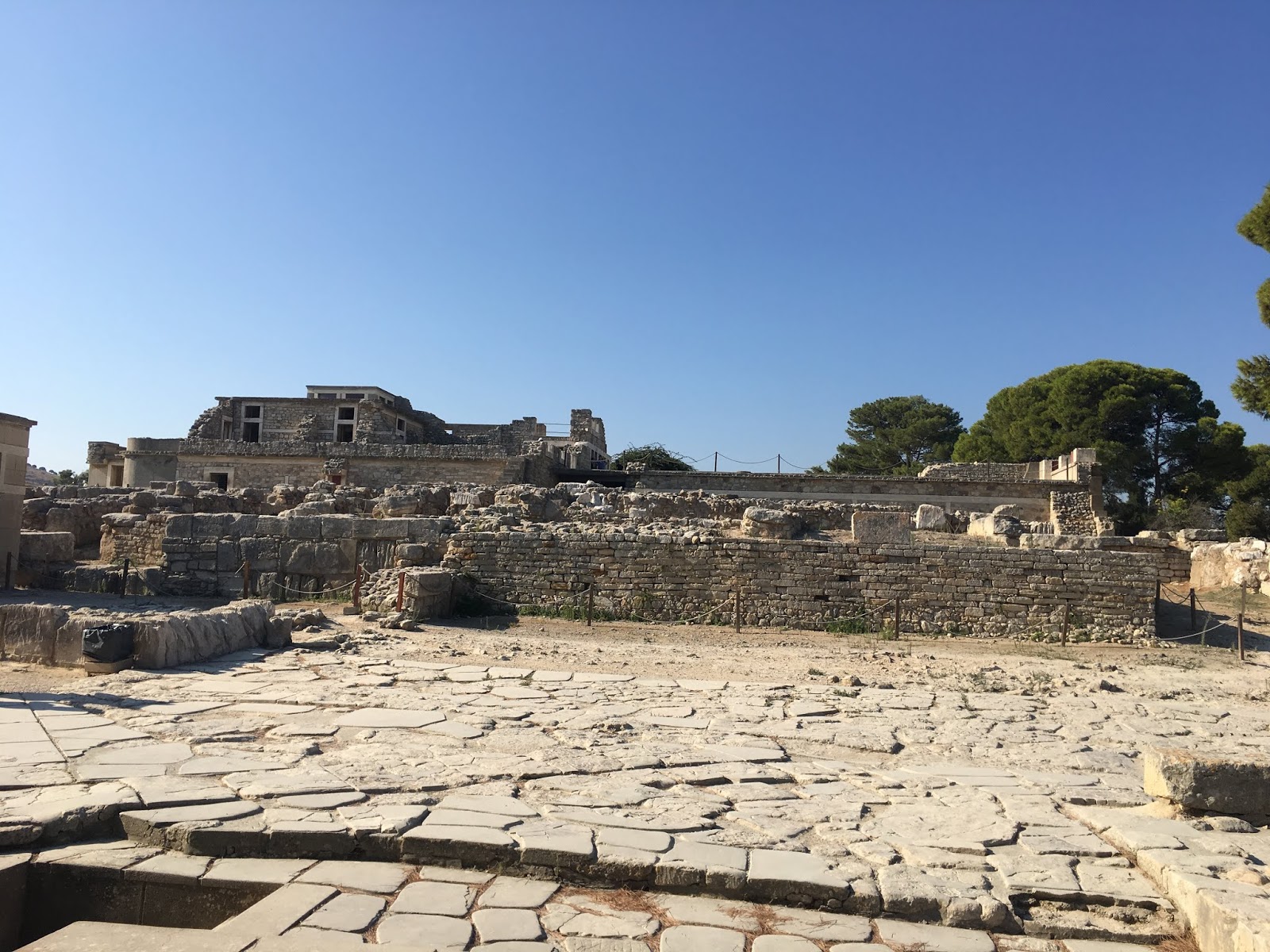
  One of the interesting aspects of our tour of the ancient 'Minoan' city of Knossos (in modern Heraklion) was the guide's repeated comment, "We often do not know where history ends and myth begins here." Many aspects of this site are reminiscent of the Greek myths that one can still read, such as the story of the Minotaur or Daedalus & Icarus. In some areas, these myths seem to be correlated to historical events; while in other ways they are clearly fictional.

Rooms within the Palace of Knossos
  This island, which we call Crete, was called Caphtor (Deuteronomy 2:23; Jeremiah 47:4; Amos 9:7) before gaining its modern name (Acts 2:11; chapter 27; Titus 1:5, 12). However, in this earliest of known advanced European civilizations, the people's own name for themselves is uncertain - thus my quotation marks around the name of 'Minoans.' Apparently the Minoans are called this because it was their king(s)' name/title.

View from the Palace to the mountain from where water was brought by aqueducts 

  The palace complex is huge, especially considering the time and the place, more than 3500 years ago. Apparently, some scholars think that the palace itself was 'the labyrinth' in the story of the minotaur.

The replicas of the paintings that are still displayed are impressive. (Originals are in a covered museum.)

Entry to "the Throne Room"


Inside the Throne Room; the throne is on the right with a bowl for washing in the center

Pictures within the throne room

Ancient sewer system that still works, although it's covered with a modern grating

Notes about the Hall of the Double Axes


Dolphin mural in the queen's room

Reconstructed wall with bull relief 
  Did you know that bull-leaping is a thing? Apparently one of the major sports of ancient Crete (and the succeeding Mycenaean culture) was leaping over a bull acrobatically, hands to the horns, back flip or hand spring off the back! Look it up online, the remaining figurines and drawings and such like are impressive.

Another side of the palace

180-degree view to give a sense of size (about a third of the Palace complex should be visible)

29 August 2019

Rhodes: a library, a castle, a church, a mosque, and the view

  I am hoping to post pictures from each of the places we visited on our trip, but it ought to be clear that we saw about 5 different locations for a couple hours over the course of 3 days. So, these pictures are by no means systematic. Mostly I just think people may enjoy having a picture of sites that they could read about in the Bible. The island of Rhodes is mentioned in Acts 21:1 where it is a brief stop on Paul's return to Syria after which he went to Jerusalem.

Church of the Virgin of the Burgh (14th century) - It has a weird history including having a road run through it. 

I find this style of mosque fascinating, but I've never actually been inside one. This one didn't have a public entrance that I could find; it may be closed.  


a Library founded by an Ottoman official a couple hundred years ago. Below are more details.
On the left, is the founding document for the Hafiz Ahmed Ağa Library. Surrounding it are translations into various languages. On the right, is a bit more history of the man and his times. 


I wish I could read the Ottoman (Arabic) script... maybe someday! The language is just an older version of Turkish, so the major hinderance is the orthography, as well as the changes that have occurred in Turkish vocabulary.

Library books, old and new
The view from the Clock Tower: notice the modern city beyond the old city walls
180-degree view from the clock tower

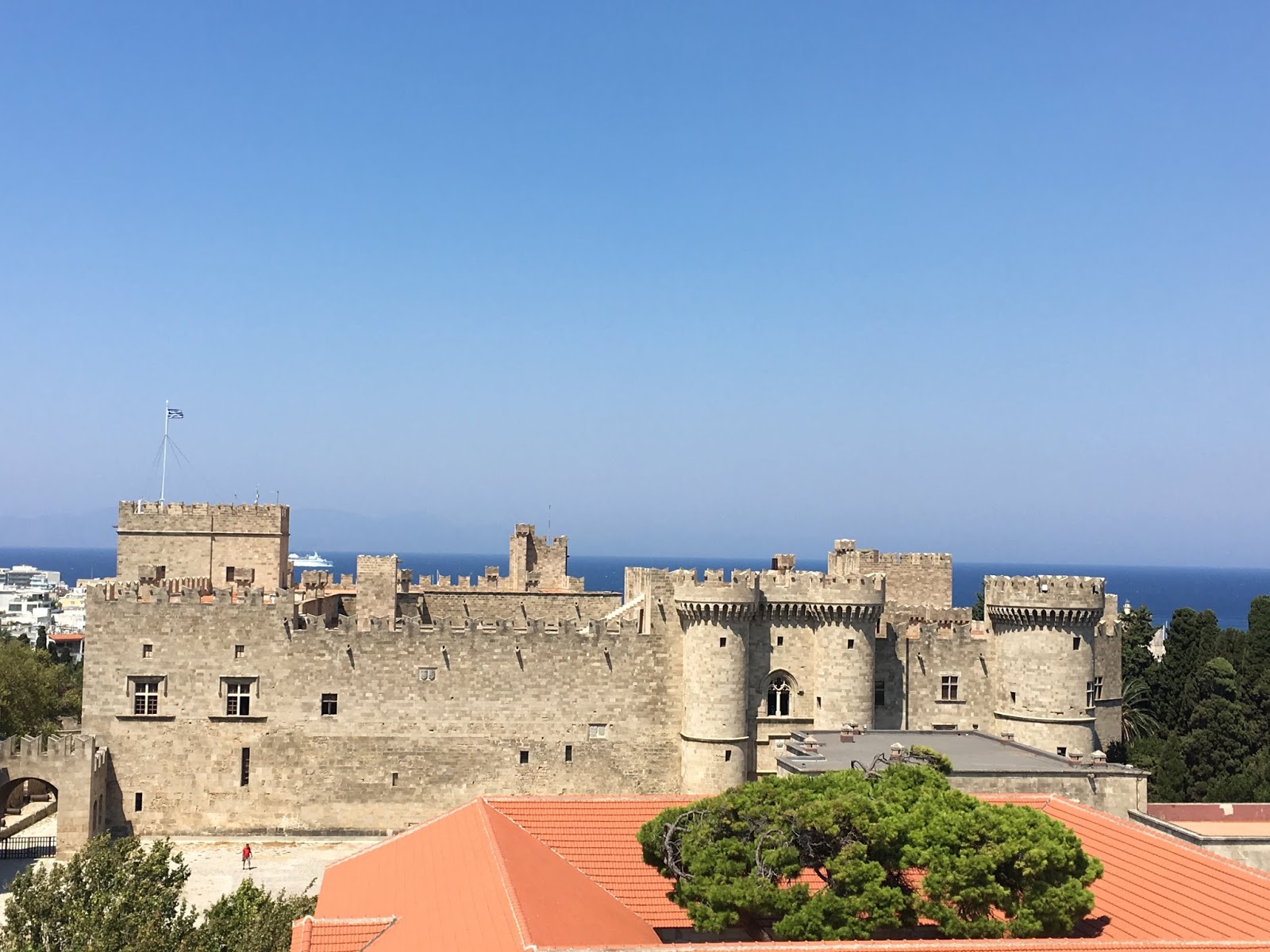
View of the castle from the tower 
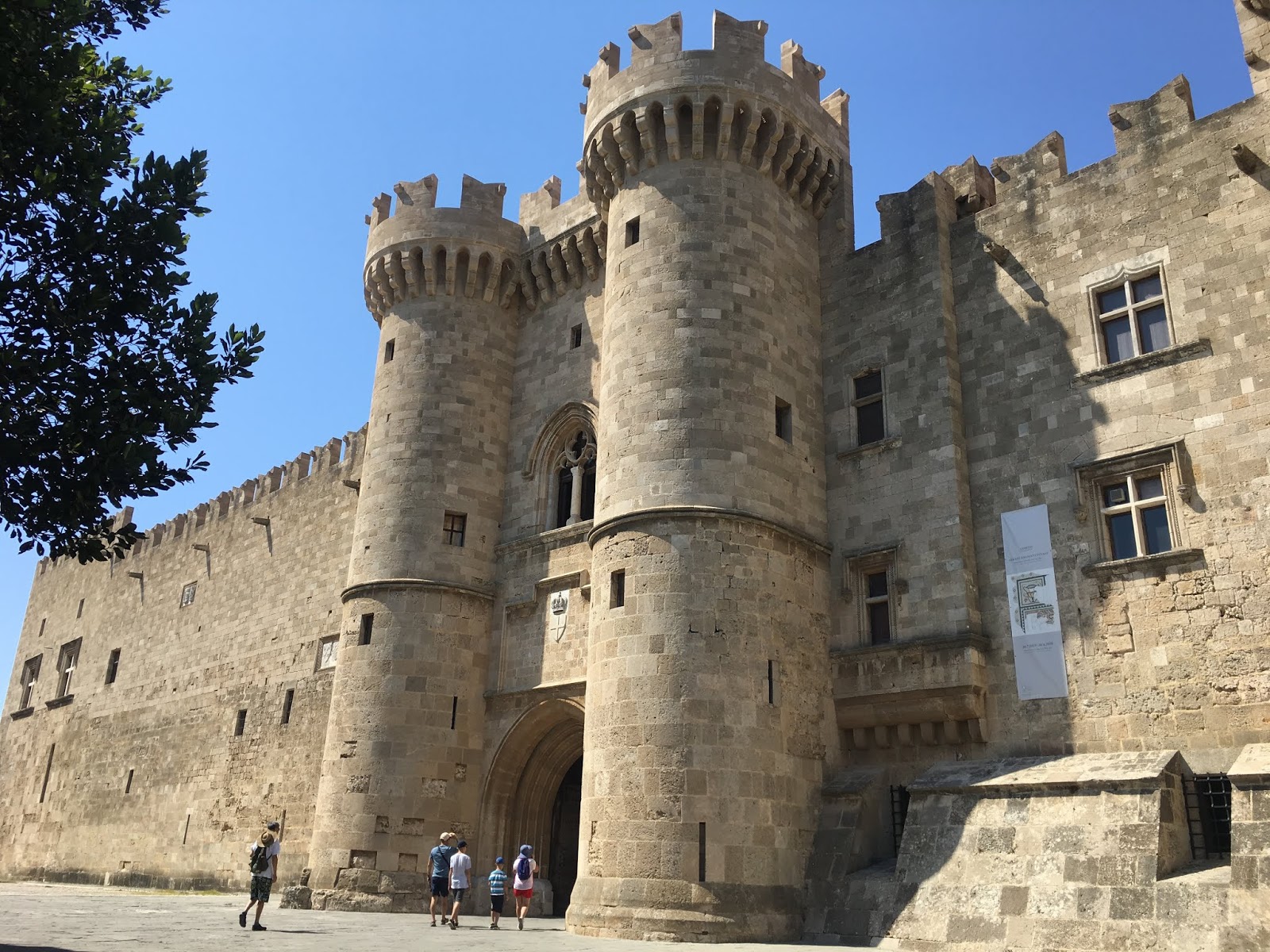
 Apparently this is technically known at "The Palace of the Grand Master of the Knights of Rhodes." Impressive, but I only saw the outside. 


06 June 2019

How many prophetesses are there in Scripture?

 A while back in my office - it was probably around International Women's Day, the discussion arose about prophetesses and whether the Bible recorded any. The colleague I was talking to is a well-informed Muslim although she's not specifically trained in theology. She didn't remember any being mentioned in the Kuran although she thought it was reasonable to assume that some of the thousands of prophetic messengers that are referenced in the Kuran were women.

  It seems likely to me that if one accepts both the speaking 'messenger' and speaking-writing 'prophet' within Islam as "prophets," it's quite likely that Eve, Mary the mother of Jesus, and other women could be considered prophets according to Islam. However, an internet search quickly shows that this is a disputed opinion, and it is certainly not one that I have the expertise to speak about.

  Anyways, for the student of the Torah, Psalms, Prophetic and Gospel writings, it is certainly clear that there were prophetesses. In fact, they are listed throughout Scripture. So, a pop quiz:

How many prophetesses are named in the Bible? Who are they?

  Who is the one in the Torah? Who are the two in the historical writings? Who is the one in the prophetic writings? Who is the one in the Gospel writings about Jesus? Who are the ones in the earliest church?

  Miriam, the sister of Aaron and Moses - Exodus 15:20 - It is not mentioned whether she married or not in the Scripture themselves. Some tradition suggests she was.
  Deborah - Judges 4-5 - Her husband is mentioned, but children are not.
  Huldah - 2 Kings 22:14; 2 Chronicles 34:22 - Her husband is mentioned though children are not.
  _?????_, unnamed wife of Isaiah - Isaiah 8:3 - Her husband was also a prophet; she had at least two sons. (Some suggest she may simply be being referred to as "the prophet's wife" in this passage, but many argue against this.)
  Anna - Luke 2:36 - She had been married, but had been widowed for a long time when she sees Jesus and is mentioned as a prophetess. (related post on "The Odd Notion of 400 Silence Years")
  The 4 Daughters of Philip - Acts 21:9 - These daughters are specifically mentioned as being unmarried at the time when they met Paul and Luke.

  Each of these prophetesses, as well as the additional women and passages below, could be considered in a lot more detail in order to develop a thorough understanding of this area. The people and priests and kings of Israel would all come to these prophetesses to consult them about the word of the LORD. Personally, I wanted to have a clear answer to the question, but the answer will always depend on the phrasing of the questions. How many prophetesses of the Lord are NAMED in Scripture? 4 along with others who like many prophets in Israel remained unnamed. How many prophetesses of the Lord are mentioned in Scripture? 8. 

Additional tidbits and relevant Scriptures:
  Joel 2:28-29; Acts 2:17-18 [cf 1:15; 2:1-4]; 1 Corinthians 11:5

  Two women are mentioned as false prophetesses as well, Noadiah (Nehemiah 6:14) and Jezebel (Revelation 2:20). In the second case, the name might be figurative.

  The Jewish Talmud (rabbis' discussions of the Scriptures) lists seven Jewish prophetesses: Sarah, Miriam, Deborah, Hannah, Abigail, Huldah, and Esther. (Megillah 14a) It is also gives the reasons each is considered a prophetess. It is interesting that the Talmud does not include Isaiah's wife.

30 March 2016

The Psalms are messianic

A logical extension of the belief that all the Scriptures point towards the Christ is that each of the Psalms is Messianic, not just some of them.  Still it is remarkable the number of Psalms which are directly related to Christ in the New Testament.

 As far as I have been able to find, there are at least 20 of the 150 Psalms that are directly referenced in the New Testament as being related to Jesus Christ. There are several other likely or possible Messianic references as seen in the chart below.

Psalm Verses References Verses References Verses References Verses

2
1-2 Acts 4:25; (Rev 19:19) (6) (Rev 14:1) 7 Acts 13:33; Heb 1:5; 5:5 9 Rev 19:15; (2:27)
8
2 Mt 21:16 4 - 6 Heb 2:6-8; 1 Cor 15:27


16
8-11 Acts 2:25-28, 31; 13:35


18
(2) (Heb 2:13b)


22
1 Mt 27:46; Mk 15:34 18 Mt 27:35; Jn 19:24 22 Heb 2:12


31
5 Lk 23:46


34
20 Jn 19:36; (Ex 12:46)


35
11 Mt 26:60 (allusion)


40
6-8 Heb 10:5-9


41
9 Jn 13:18 10 MESSIANIC?


45
6-7 Heb 1:8-9


68
18 Eph 4:8


69
4 Jn 15:25 9 Jn 2:17; Rom 15:3 21 Acts 1:20 25 Acts 1:20
78
2 Mt 13:35


86
(6) (Jn 10:34)


89
3-4, 35-36 Acts 2:29-30


91
11 - 12 Mt 4:6; Lk 4:11-12


96
(13) (Rev 19:11)


97
(7) (Heb 1:6)


102
25-27 Heb 1:10-12


109
3 Jn 15:25 8, 17 Acts 1:20; Jn 17:20


110
1 Mt 22:42; Mk 12:36; Lk 20:42, 43; Acts 2:34-35; Heb 1:13 4 Heb 5:6, 10; 7:17, 21 (5-6) (Rev 6:15-17)


118
22-23 Mt 21:42; Mk 12:10-11; Lk 20:17; Acts 4:11; 1 Pet 2:7 25-26 Mt 21:9; Mk 11:9; Lk 13:35; 19:38; Jn 12:13


132
11 Acts 2:29-30


A beautiful depiction of the interlocking nature of the Bible's text is available here.


The chart above as an image:


Kindly message me if you see any errors in the chart!
Related post: on the use of the OT