...observations and ramblings from a learner and traveler...

Showing posts with label Meditations. Show all posts

22 September 2024

Hopkins' 'Peace' - "That piecemeal peace is poor peace!"

  I was introduced to lots of poetry when I was young, and I memorized a good bit of it too, both by choice and due to curricular requirements. However, it's only been in the last few years that I have begun to appreciate more complex verse. Bits of T. S. Eliot's Four Quartets wooed me (Trying to learn to use words, and every attempt... OR The wounded surgeon plies the steel...) and drew me into that set of poems. Now a book of Gerard Manley Hopkins' work has been [kindly] thrust upon me. It's often complex to the point of feeling incomprehensible at first, and yet... there's something there. This one, 'Peace' felt meaningful today, both personally and globally.


Peace

When will you ever, Peace, wild wooddove, shy wings shut,

Your round me roaming end, and under be my boughs?

When, when, Peace, will you, Peace? I'll not play hypocrite


To own my heart: I yield you do come sometimes; but

That piecemeal peace is poor peace. What pure peace allows

Alarms of wars, the daunting wars, the death of it?


O surely, reaving Peace, my Lord should leave in lieu

Some good! And so he does leave Patience exquisite, 

That plumes to Peace thereafter. And when Peace here does house

He comes with work to do, he does not come to coo,

He comes to brood and sit.

27 July 2024

some words of Ignatius to the Ephesians

  Continuing (earlier post) through the Apostolic Fathers in the beautiful translation by Michael Holmes, I have now come to Ignatius' letters to the churches as he was taken to an expected execution for the sake of Christ. This was most likely during Trajan's (98-117) or possibly Hadrian's reign (117-138). These words, chapters 7-9 of his letter to the Ephesians, are picturesque and powerful in speaking to both the devotional and daily life of the Christian. The entirety is worth reading; but I've highlighted a few spots.

7 For there are some who are accustomed to carrying about the Name maliciously and deceitfully while doing other things unworthy of God. You must avoid them as wild beasts. For they are mad dogs that bite by stealth; you must be on your guard against them, for their bite is hard to heal. 2 There is only one physician, who is both flesh and spirit, born and unborn, God in man, true life in death, both from Mary and from God, first subject to suffering and then beyond it, Jesus Christ our Lord. 

8 Therefore let no one deceive you, just as you are not now deceived, seeing that you belong entirely to God. For when no dissension capable of tormenting you is established among you, then you indeed live God's way. I am a humble sacrifice for you and I dedicate myself to you Ephesians, a church that is famous forever. 2 Those who belong to the flesh cannot do spiritual things, nor can those who are spiritual do fleshly things, just as faith cannot do the things of unfaithfulness, nor unfaithfulness the things of faith. Moreover, even those things that you do according to the flesh are in fact spiritual, for you do everything in Jesus Christ.

9 But I have learned that certain people from elsewhere have passed your way with evil doctrine, but you did not allow them to sow it among you. You covered up your ears in order to avoid receiving the things being sown by them, because you are stones of a temple, prepared beforehand for the building of God the Father, hoisted up to the heights by the crane of Jesus Christ, which is the cross, using as a rope the Holy Spirit; your faith is what lifts you up, and love is the way that leads up to God. 2 So you are all participants together in a shared worship, God-bearers and temple-bearers, Christ-bearers, bearers of holy things, adorned in every respect with the commandments of Jesus Christ. I too celebrate with you, since I have been judged worthy to speak with you through this letter, and to rejoice with you because you love nothing in human life, only God.


25 May 2024

the good news in a prayer

Here's a bit more from Clement of Rome. The second bolded portion (verse 4) reminds me very much of the terms Jesus used to declare 'the good news (or gospel) of the kingdom of heaven'. A truly beautiful prayer that reflects a certain universality of the compassion of God towards his people in every condition of need. In this sense, the Gospel offers no comfort to the need-less or sufficient; and yet, every type of human need is of importance to the Primal Source of all creation.

  [Grant us, Lord,]* to hope on your name, which is the primal source of all creation, and open the eyes of our hearts that we may know you, who alone are highest among the high; you are holy, abiding among the holy. You humble the pride of the proud; you destroy the plans of nations; you exalt the humble and humble the exalted; you make rich and make poor; you kill and make alive. You alone are the benefactor of spirits and the God of all flesh, looking into the depths, scanning the works of humans; the helper of those who are in peril, the savior of those in despair; the creator and guardian of every spirit. You multiply the nations upon the earth, and from among all of them you have chosen those who love you through Jesus Christ, your beloved servant, through whom you instructed us, sanctified us, honored us. 4 We ask you, Master, to be our helper and protector. Save those among us who are in distress; have mercy on the humble; raise up the fallen; show yourself to those in need; heal the sick; turn back those of your people who wander; feed the hungry; ransom our prisoners; raise up the weak; comfort the discouraged. Let all the nations know that you are the only God, that Jesus Christ is your servant, and that we are your people and the sheep of your pasture.
~~~
 1 Clement 59:3-4 
*the very first 3 words are the editor’s emendation

09 December 2023

Who gets to give the gift? & Is that the answer to my prayer?!?

  Romans 1 is quite common passage to hear sermons on; this probably explains why a rather unremarkable connection that I made today seemed remarkable to me. I've heard this passage discussed so many times, but I've never seen it connected to this one part of its larger context, the preceding chapter.

  The New Testament writings are arranged in sets with the narrative portions (the 4 Gospels and the Acts of the Apostles) at the beginning, followed by Paul's letters (largely arranged in descending order of length), and then the letters and writings of the other earliest leaders of the followers of Jesus's way. Due to this arrangement, the first chapter of Romans immediately follows the last chapter of Acts. However, chronologically Romans 1 actually precedes Acts 28 by about 2-3 years.

  In Romans 1, Paul expresses his long-term desire, prayer, and intent to come to Rome to share with the Roman believers and to be shared with by them. He longingly awaits God’s will in the timing of this visit.[1]

For God is my witness, whom I serve with my spirit in the gospel of his Son, that without ceasing I mention you always in my prayers, asking that somehow by God’s will I may now at last succeed in coming to you. For I long to see you, that I may impart to you some spiritual gift to strengthen you— that is, that we may be mutually encouraged by each other’s faith, both yours and mine. I do not want you to be unaware, brothers, that I have often intended to come to you (but thus far have been prevented), in order that I may reap some harvest among you as well as among the rest of the Gentiles. (Romans 1:9-13, ESV)

   When this passage is combined with the events leading to Paul's actual arrival in Rome, we get a beautiful, difficult, and instructive example of the interweaving of human desire and intent and request with divine design and purpose. Paul's circumstances upon arrival were certainly not the ones he would have proposed for his visit to Rome (see Romans 15).[2]

 Anyways, in the 18 verses of Acts 28 which deal with Paul’s time in Rome, we find that it was the Roman family of Christ who first encouraged Paul! Having arrived after a long-term detention, a journey as prisoner to the Emperor’s tribunal, and a shipwreck, Paul needed encouragement, and it was the Roman ‘brothers’ who provided it by coming out to meet Paul's group (Acts 28:14-15). This seems to initially reverse Paul’s major hope to serve and strengthen the Roman believers. Instead of strengthening and encouraging others, the apostle finds himself being encouraged and strengthened! This is a fabulous reminder that even a 'great spiritual leader' will often need encouragement from 'ordinary believers', even when they don't expect to need it. Paul came primarily expecting to give a spiritual gift, but when he arrived, it was he who needed to receive one. 

   These passages together also give a beautiful view of the way in which divine and human will and desire can work together. They hint again at how our prayers often are answered not by giving us our imagined answers but by giving the divinely-prompted deeper desires which lie at the root of the prayer. Thus, the path to answered prayer and walking willingly in God's will is often much more complex, difficult, and unexpected than our conscious prayers. May our prayers be Spirit-prompted and our reception of them received gladly from the hands of our loving Father.


[1] Later, in Romans 15, Paul mentions more details about his desired journey and how he plans to use a visit to Rome as a springboard for a journey to the far West (to Spain).

 In Romans 1, Paul also speaks of proclaiming the Good News to both Jews and Gentiles, those who have already believed and those who have not yet. Both of which are also dealt with in Acts 28.


[2] Regardless, based on his attitude toward ministry in Jerusalem (cf Acts 21:1-15), Paul probably wouldn't have changed paths even if he had known these circumstances.


10 October 2023

The Drier of Tears


    And [the Lord of hosts] will swallow up on this mountain
        the covering that is cast over all peoples,
        the veil that is spread over all nations.
    He will swallow up death forever;
    and the Lord GOD will wipe away tears from all faces,
        and the reproach of his people he will take away from all the earth,
        for the LORD has spoken. (
Isaiah 25:7–8, ESV)

The exalted title the Sovereign LORD calls attention to the fact that in all the dignity of his divine sovereignty, it is the Lord himself who will attend to our tears, moving from person to person until each eye has been dried. On the disgrace of his people cf. Joshua 5:9 where the rite of circumcision was renewed for the Lord’s people. It symbolized that the days of covenant abeyance were over and that the ‘disgrace of Egypt’ was gone – the disgrace to the Lord’s people of living in slavery, bondage and misery. So also, as long as life in this world endures, there are innumerable ways in which the people of God are under reproach and hindered, by circumstances and sin, from living according to their true dignity. All this will be taken away. The new nature will be given full and glorious expression in an environment where everything conduces to holiness (cf. Phil. 3:20–21). Covenant promise will have become covenant reality.(Motyer, 210, Kindle) 

 ‘The Drier of Tears’, of course, brings the Psalmist’s bottled tears to mind as well as the more well-known reflections of this passage in John’s Revelation. Imagine a loving parent as they comfort a child and wipe away the tears of their hurt child. They do not deny the pain, but they comfort and enter into it. They encourage the child with reasons that things will end okay and that the pain will not conquer. This Sovereign’s attentions are not the ‘be tough’ shushing of an impatient or distant parent to a child genuinely in pain, nor does the Sovereign unnecessarily comfort an emotional or manipulative outburst. 

 Instead the image given here is the Sovereign Lord squatting down before each child taking them in turn and re-opening all those bottled tears which have been stored up, not to re-live the pain but to engage its reality with empathy and bring resolution and full healing. Waiting with each tear till it has been dried, the Sovereign Lord stills and heals the heartbreak of all of His own: each loss, each grief, each pain, each betrayal, every agony of birthing, all the reproach which has been heaped on the child publicly or privately whether by themselves or others, each unfulfilled longing, every scarcely understandable cry of rage, each pang of guilt and insufficiency, every moment of teeth-gritting or of grinning-and-bearing-it, all the despair and disillusionment, in short, all the groaning and mourning and suffering which had been brought on by the curses in this cosmos. All of these heartcries will be engaged, even authenticated, and defanged by the One who values what may have, until that moment, been unseen and unacknowledged by any other in the universe. 

  Within this context, the sorrows of judgment must be mentioned; the tears which were mourned in the Lord’s comprehensive judgment of chapter 24 will also be dried. This One pauses for each tear till the heart that has held it is clear, the eye that it trickled from is dried. At that moment, nothing will be more important than these hurts and this healing. This is a key piece of the great salvation, and it will not be denied! Isaiah insists upon this point (Isa 30:19; 35:10; 51:11; 65:19). May hope in the Drier of Tears, who is also the Remove of Reproach, steady our hearts.

NOTE: There is no destruction of the human emotional capacity here; this is a making well of heartache. In the context (notice Isaiah 26), there is a full range of emotions during and following the ‘healing of sorrows.’ This is about healing and wellness, not simply or superficially about tears; tears are foregrounded as the powerful symbol summarizing the need for comprehensive healing. So, it is about tears; they are vitally important, but they are not ultimate, they will pass at the right time.

03 February 2023

Philippians and the Presence


The Albanian Alps
The Albanian Alps
 

  That the Maker of this unimaginably great universe would approach -draw near to- creatures he made is one of the great mysteries and realities in the Bible. What kind of God cares about minute creatures on a tiny planet in the midst of this stunning magnificence, especially ones who have rejected his lordship? Yet, throughout Scripture, we do not only find the Maker coming as a Judge of rebels, though that is certainly part, and we do not only find a Presence through pure symbol like fire or cloud or dove, but we also see the approach of intimate call to relationship and friendship with the One. Of course, this was manifested ultimately when God became human enfleshed. [This is not the often-accused impossibility that a human should somehow became GOD, but the belief that GOD stooped low to become one of us.]

  As I've been reading in Paul's letter to the Philippians, I was struck by the practical relevance of the Lord's presence for the Jesus-follower. In 4:5-6 (below), the soon-coming or approach of the Lord is the basis for not worrying. In other words, don't worry about the future because the Lord will be there. Several verses later, Paul says, the way to practice right thought and action is with the knowledge of the God of peace's current presence with you. In other words, you can live in God's way now because the God who will gives peace is actually with you. 

  Since these verses about the presence of God in the future and the present came so close together, I wonder if this letter mentioned the presence of God in the past with these sorts of practical implications. And it does. In chapter 2:4-8, Paul writes that Jesus-followers are to have a sacrificial and unified attitude towards each other and others. Then he gives the basis of this as such an attitude is already 'yours in Christ Jesus' because of Jesus' past presence in coming and dying, along with his exaltation. From other Scriptures, we can see that being 'in Christ Jesus' relates directly to our being in the Presence. So, we have here the past presence of God enabling a God-ward present inner life and attitude. 


Let your reasonableness be known to everyone. The Lord is at hand; do not be anxious about anything, but in everything by prayer and supplication with thanksgiving let your requests be made known to God. And the peace of God, which surpasses all understanding, will guard your hearts and your minds in Christ Jesus.
Finally, brothers, whatever is true, whatever is honorable, whatever is just, whatever is pure, whatever is lovely, whatever is commendable, if there is any excellence, if there is anything worthy of praise, think about these things. What you have learned and received and heard and seen in me—practice these things, and the God of peace will be with you. (Phil 4:5-9, ESV)

Let each of you look not only to his own interests, but also to the interests of others. Have this mind among yourselves, which is yours in Christ Jesus, who, though he was in the form of God, did not count equality with God a thing to be grasped, but emptied himself, by taking the form of a servant, being born in the likeness of men. And being found in human form, he humbled himself by becoming obedient to the point of death, even death on a cross. (Phil 2:4-8, ESV)


19 September 2022

Moses' poem about life's brevity and futility (Psalm 90)


With its introductory note, Psalm 90 is placed in the context of Moses’ life, you can easily see how Moses could write a psalm like this as he lived to watch nearly all of the adults around him age and die in the wilderness. The brevity of life and its difficulty and the wrath of God must have often seemed very near to him.

As I read this beloved poem again this morning, I was struck by themes that echo within it, like mortals' troubles and divine responses. As you can see in the diagram, it seems to me that the first 2 verses form a sort of introduction of praise establishing the setting of God’s eternality or existence beyond the clutches of time. In verses 3-4, humans’ return to dust is mentioned and given as a command; this is matched in verse 13 by a call for God’s return, and both are followed by a concern for length of time.

Following that, there is the issue of being swept away in the temporary, dreamy, impermanent joy (of life’s morning) followed by the fading, withering sorrow of the evening, in verses 5 and 6. The response to this in verse 14 is that the Lord who is our dwelling place can satisfy us not only in the morning, but also the whole day long with joy.

Verses 7 to 11 directly bring out the theme of God’s anger and our unhidden sins, and we learn that the brevity of our lives is connected with these points. (In my opinion, the KJV translation draws out the emphasis in verse 10 on the extreme brevity of mortal life better, reflecting the Hebrew as ‘the days of our years’. In other words, even if  we count each individual day of all of our years, life’s still naturally going to end very quickly and sadly.) The response to this in verse 15 is that the Lord can give gladness to offset the affliction and evil of many days and many years.

Finally, there is a response to the ‘toil and trouble’ of verse 10 at the end of the poem (verses 16 and 17). Instead of us wasting our energy in meaningless, quickly-ended toil, may the Lord work on behalf of His servants. (Isn’t that beautifully backwards!) Beyond that, God’s favor can turn our toil and trouble into meaningful work.

The psalm hinges on 2 points in this way of organizing it. After the foundation of God’s immovable reality outside of our temporal troubles and our living within the Great Reality has been laid, verse 12 summarizes the first part of the psalm by asking that God teach us to count each day in order to gain wisdom through acknowledging life’s passing nature. Such an awareness of our mortality and futility can lead us away from futility. Secondly, in verse 17, we find that the favor of our Lord can reverse life’s futility and actually establish the work of our hands! Life can not only be joyful; it can also be meaningful when the Lord’s face shines on us. What stunning grace!


NOTE: Not all the psalms end in such a happy resolution; for example, Psalm 88 does not exude any explicit hope, at least when considered on its own. 

25 April 2021

A White Stone, with a Secret Name

Photo by Who’s Denilo ?

  In my recent reading of Adorning the Dark, a passage from this old 'unspoken' sermon on 'The New Name' by George MacDonald was mentioned. I've included some excerpts below. While there are many places in the Scriptures where the communal or corporate identities of God's followers are emphasized, the particular verse in this sermon is strikingly focused on the individual. It is sourced in the promise of Jesus:

To the one who conquers I will give some of the hidden manna, and I will give him a white stone, with a new name written on the stone that no one knows except the one who receives it.’ 
Revelation 2:17b

Photo by Edgar Soto

The true name is one which expresses the character, the nature, the being, the meaning of the person who bears it. It is the man's own symbol,--his soul's picture, in a word,--the sign which belongs to him and to no one else. Who can give a man this, his own name? God alone.
...

God's name for a man must then be the expression in a mystical word--a word of that language which all who have overcome understand--of his own idea of the man, that being whom he had in his thought when he began to make the child, and whom he kept in his thought through the long process of creation that went to realize the idea. To tell the name is to seal the success--to say, "In thee also I am well pleased."
...

To him who climbs on the stair of all his God-born efforts and God-given victories up to the height of his being--that of looking face to face upon his ideal self in the bosom of the Father--God's him, realized in him through the Father's love in the Elder Brother's devotion--to him God gives the new name written.
...

But I leave this, because that which follows embraces and intensifies this individuality of relation in a fuller development of the truth. For the name is one "which no man knoweth saving he that receiveth it." Not only then has each man his individual relation to God, but each man has his peculiar relation to God. He is to God a peculiar being, made after his own fashion, and that of no one else; for when he is perfected he shall receive the new name which no one else can understand. Hence he can worship God as no man else can worship him,-- can understand God as no man else can understand him. This or that man may understand God more, may understand God better than he, but no other man can understand God as he understands him. God give me grace to be humble before thee, my brother, that I drag not my simulacrum of thee before the judgment-seat of the unjust judge, but look up to thyself for what revelation of God thou and no one else canst give. As the fir-tree lifts up itself with a far different need from the need of the palm-tree, so does each man stand before God, and lift up a different humanity to the common Father. And for each God has a different response. With every man he has a secret--the secret of the new name. In every man there is a loneliness, an inner chamber of peculiar life into which God only can enter. I say not it is the innermost chamber--but a chamber into which no brother, nay, no sister can come.

From this it follows that there is a chamber also--(O God, humble and accept my speech)--a chamber in God himself, into which none can enter but the one, the individual, the peculiar man,--out of which chamber that man has to bring revelation and strength for his brethren. This is that for which he was made--to reveal the secret things of the Father.

...

And what an end lies before us! To have a consciousness of our own ideal being flashed into us from the thought of God! Surely for this may well give way all our paltry self-consciousnesses, our self-admirations and self-worships! Surely to know what he thinks about us will pale out of our souls all our thoughts about ourselves! and we may well hold them loosely now, and be ready to let them go.
...

[Application:]
Ambition is the desire to be above one's neighbour; and here there is no possibility of comparison with one's neighbour: no one knows what the white stone contains except the man who receives it. Here is room for endless aspiration towards the unseen ideal; none for ambition. Ambition would only be higher than others; aspiration would be high. Relative worth is not only unknown--to the children of the kingdom it is unknowable.

Photo by bantersnaps


27 February 2021

Wasteful Wardens of the Planet

  This is a hard topic to write about. It's easier to express the ideas in speech, but then the details don't usually all get explored before the conversation wonders. So, in keeping with one of the purposes of this blog, I am going to try again to express the question of "Humans as Wasteful Wardens." I deleted my first attempt a couple years ago, but the idea keeps coming up. So, let me try to outline its key pieces.

  1. I believe that humans were designed to be gardeners, stewards of the earth - or, maybe even of the galaxy! There is a care and compassion inherent to gardening that is so natural that it may not get much thought. Gardeners seek fruit or flowers, which requires healthy plants, which require healthy soil, which requires investment of time and work and attention and study. Shouldn't that be us all around the world - each in our own plot of land, seeking healthy provision and beauty and flourishing?
  2. I believe that our Maker also designed us to multiply humans who would reflect the Maker's own image partially through elaborating on the designs built into the world. In other words, the world had been designed flawless but still had space for improvement, even in Eden! Shouldn't we be pursuing the development of what was given, whether physical or mental or spiritual or social?
  3. I believe in entropy: the world is falling into disorder, and inevitably we are increasing that disorder. Since its goodness was shattered, this universe has been gradually deteriorating. Theologically, we might speak of 'sin'; scientifically, we might speak of 'the second law of thermodynamics'. Both concepts tell us that this world is not what it once was and is headed for destruction. What's worse is that we are involved, as a cause. Shouldn't we be fighting against the destruction?
  To summarize, while the world was designed to be good for humanity, humanity was also designed to be good for the world. However, our daily existence shows us that often the world is not good for us, and we are often not good for it. This should naturally lead to a bad end. Is there another way? 

Turkish kebab

 On the one hand, I'd really like to be 'green,' but I can't 
commit to greenness as an ideology. I can't get past its meaningless, vicious cycle. Which one? Well, imagine that I ate some kebab... at some point, I would need to wash the plate. Now, I could save it with lots of other dirty dishes and run it through the dishwasher, or I could just wash it by hand. They both consume resources though different amounts of different resources with different fall-out for the health of the earth, its systems, and my co-inhabitants. I also have the option of NOT washing the plate - so as to save water and to prevent chemical pollution. However, that may end up with me in the hospital consuming vastly more resources than I otherwise would have. In fact, no option removes me as a consumer and polluter. (Oh, and we didn't touch on the topic of the good kebab that God provided; that would be another place to consider how we are 'gardening our world'.) In every case, it feels like I am wasting or destroying part of the exact thing that I was to be enhancing, the world that I was made a steward of! I am not suggesting here that this is my only effect on the earth; I am simply suggesting that it seems inevitable that I will have some negative impact. 

 Here's a fascinating case study: This BBC article on deep sea mining shows plainly how we humans struggle to balance exploring, appreciating, and using the resources that we find. So, I am left to wonder: Can we garden without greed? Can we explore without exploitation? Can we contribute while we consume? Can we enhance while we expand? Those who love the God revealed in the Bible should be at the forefront of seeking ways to do this; that was the original design! Of course, we can't "save the planet," but we should certainly care for it as well as we can. As in so many other areas, we must value what we have been given without worshipping it. At the same time, we must engage in brokenness without trying to become the Savior.  

  Graciously, there is a solution from outside the system. If the Designer of the world were to engage the world in healing by sending help from outside the system, healing would become possible at more than a temporary or partial level. The Bible's claim is that such help has and will come. So, while recognizing the temporal hopelessness of saving the environment, it is possible for a person to garden in the world as best as they know how and also to look for a Healer who will bring in the opposite of entropy! Isaiah describes The One who will bring an increase of peace without end (9:7). How will goodness increase forever? I don't know, but I am eager to be shown.

  For thought or comment: 
  • How can we apply ourselves (individually or communally) to gardening whatever space we have?
  • Where can we create beauty around us?
  • What do I see that needs restoring near me?
  • What would I do differently if I saw myself as steward of the earth and took responsibility for such a stewardship of land and co-inhabitants?

24 October 2020

on Prophets (and Miracle Workers) - with 3 trivia questions

 Three trivia questions: (answers at the bottom of the post)

 a. Who was the first miracle worker mentioned in the Bible?

 b.  Who is the first person who is called a prophet in the Bible?

 c. How many prophets are listed as such before the first prophetess is recorded? 

The Prophet as Intercessor

   Especially in the second instance, I would say that the answer is a person whom we do not often consider to be a prophet. Yet, the Lord calls him one. More interestingly, the logic of being a prophet is given like this, "Make this right, and he is a prophet, so he will pray for your healing." This is an interesting role for the prophet, the Prophet as Intercessor. This is the role that we often ascribe to the priest, and rightly so. However, here it is so, and maybe elsewhere? Incidentally, this prophet had just interceded for God's mercy on pagan cities two chapters before in Genesis 18. But maybe we find here that intercession is also a function of being a prophet. 

The Prophet as the Speaker of God's Word

  Further thoughts, I have been reading through the OT Historical Books, describing the first nation(s) of Israel from the death of Moses through their exile from their Promised Land centuries later. One of the fascinating features of these stories is a stream of references to 'prophets,' plural. Among the people that I have known who take Scripture seriously, I suspect many of us think of prophets as solitary and sporadic icons throughout biblical history; we'd quickly list Moses, Samuel, Nathan, maybe Gad, Elijah, Elisha, and then skip forward probably to the writing prophets like Daniel and Jonah and Isaiah, (probably also forgetting most of the prophetesses whom I wrote about a while back.) But that notion of the 'rare prophet' of Israel doesn't bear up under closer study of Scripture. Prophets were often relatively common, though not always (1 Sam 3:1). 

 The idea that prophets were rare probably reflects the relative space given to describing the activity of individual prophets. However, it does not reflect the actual nature of the prophetic role in Israelite society at that time. Now, springing to mind for some might be 'the sons of the prophets' who make appearances throughout Elijah and Elisha's stories: Obadiah hid 100 prophets in Ahab's time (1 Kings 18), and 2 Kings 2 records 'sons of the prophets' living in Bethel and Jericho, numbering at least 50. And indeed, there seem to have often been many prophets scattered throughout the society. 

- Pre-Samuel prophets/prophetesses: Exodus 7:1; 15:20; Numbers 11:25-29; Judges 4-5; Judges 6:8

- Saul meets a group of prophets after leaving Samuel and joins them in prophesying (1 Samuel 10:5-13)

- Saul and his messengers meet a company of prophets led by Samuel and join them in prophesy (1 Samuel 19:20-24)

- 1 Kings 13 has the odd story of two unnamed prophets who speak the word of the Lord, although one lies about this at one point. The purpose of this story seems to be to show the corruption of even true prophets during this time. But for our study, that is not key for now.

- Then, there are named prophets (and a prophetess) who are mentioned more briefly: many sons of Asaph, Heman, and Jeduthun who prophesied are mentioned (1 Chr 25:1-5); Asaph the seer (2 Chr 29:30); Shemaiah (1 Kings 12:22; 2 Chr. 12) Ahijah the Shilonite (1 Kings 11) and Iddo the seer (2 Chr 9:29), Huldah (2 Kings 22:14), Azariah, (2 Chr 15:8), Hanani the seer (2 Chr 16:7-10), Jehu, son of Hanani (1 Kings 16:1-7; 2 Chr 19:2), and Micaiah (1 Kings 22). (Organized roughly chronologically)

- 1 Kings 20 has 2 separate stories of unnamed prophets who deliver messages to Ahab, King of Israel.

- The sons of the prophets mentioned right before Elijah was taken up to heaven are mentioned again in 2 Kings 4, 5, 6, and 9.  

- 2 Chronicles 33:18 speaks of multiple seers speaking God's word to Manasseh.

- Many of the Writing Prophets are also mentioned within the Historical Books though their stories are often unrecalled because of the focus on the texts they left. Isaiah (2 Kings 19-20; a major prophet even without the book), Jonah (2 Kings 14:25), Haggai and Zechariah (Ezra 5:1-2; 6:14).

The Prophet as Scribe

 Interestingly, many of the prophets seemed to have a history-writing role, though whether these are the recorded Scriptures that we have is not necessarily as clear. 1 Chronicles 29:29 mentions Samuel, Nathan and Gad in this regard. Nathan, Ahijah, and Iddo are listed in 2 Chronicles 9:29; Shemaiah and Iddo are mentioned in 2 Chronicles 12:15; and Iddo is mentioned again in 2 Chronicles 13:22. Also, Isaiah is recorded in this light (2 Chr 26:22; 32:32).

 The history of prophets and prophecy in Scripture is much broader than we often think about, and this is before we even consider the NT implications. Likely there are many more Scriptures that could be added to this discussion, feel free to do so if they will enrich our understanding!


Additional passages: 2 Samuel 15:27 - a high priest called a seer; 2 Chronicles 24:27 - 'many oracles'; 2 Kings 17:13 - warnings to Israel 'by every prophet and every seer' to turn from wickedness; 1 Sam 9:9 - equates seers with prophets; Zechariah the son of Jehoida (2 Chr 24:20); Isaiah 8:3 (unnamed prophetess).


Answers:

a. Moses (Ex 4:1-9 and beyond), as far as I can tell. Can you think of any previous instance where someone performs a miracle? Joseph's dream interpreting may be the closest, but dream interpreting seems like its own separate category. 

b. Abraham (Gen 20:7)

c. Two (Only Abraham and Aaron are named as prophets before Miriam. Deborah follows quickly as well with only Moses [Deut 18:15] and the incident in Numbers 11 intervening)


Related posts: The Odd Notion of 400 Silent YearsHow Many Prophetesses are there in Scripture?

04 July 2020

"Your Father, the Devil": Satan as a Father in the Bible

 As a father of growing and changing children, I want to keep growing in both my understanding and practice of fatherhood. Recently, I was thinking of the fact that Satan is discussed as a father in Scripture. So, it seemed worth exploring what characteristics are associated with devilish fatherhood.

 The images and metaphors associated with the devil are almost always violent or oppressive in some way whether emotionally (hatred, wrath, tempt, incite, furious), physically (contend, death, snare, take away, bound, devour), mentally (deceit, lies, schemes, disguise), or social (accuse, harass). 

Meanwhile, the images and metaphors associated with God may also at times be violent (Genesis 6:13; Exodus 15:3), but they are neither exclusively nor predominately so. Indeed, the names of God particularly associated with fatherhood are of a particularly different variety (Father of the fatherless, Holy Father, our Father in heaven, the Father of glory, the Father of mercy, the Father of lights, the living Father, etc.)  Along with their sources in the Bible, these can be seen in the 'Biography of God' that I posted some years ago.  

So...

In Scripture, what traits are associated with the fatherhood of Satan/the devil / the evil one? 

What qualities in a father are not sourced in the fatherhood of God?

-       John 8:34-47 (38, 41, 44) - The devil and his children...

o   lie, "the father of lies"

o   fight against truth

o   murder; seek to kill

o   cannot bear to hear the word of Christ


-       1 John 3:8-15 (8, 10, 12) - The one who is of the evil one...

o   Makes a practice of sinningDoes not practice righteousness

o   Does not love his brother

o   Hates and murders his brother


-       Matthew 13:24-30, 36-43 (38-39) - the children of the evil (one)...

o   intermingled with those of the Heavenly Father and may be indistinguishable from those of the Father’s kingdom even to the angels. (cf 2 Cor 11:14)


-       Acts 13:6-12 (10) - This particular example of a 'son of the devil'...

o   opposed God's messengers and sought to turn another person away from the faith 

o   was an enemy of all righteousness

o   was full of all deceit and villainy

o   made crooked the straight paths of the Lord (cf. Luke 3:3-5; the opposite of John the Baptist) 

  Other references that seem vaguely relevant but not really: Matthew 23:15; Ephesians 2:2-3; 5:6;  John 17:12; 2 Thessalonians 2:3; 2 Peter 2:14

  If you have any thoughts or passages or disagreements to contribute, I'd be interested to hear them on here or in person.

23 April 2019

A Turkish Shepherd Calling His Own Sheep (and someone else's!)

  About a month ago, one of the most interesting videos I've seen came into the news here in Turkey (news article about it). It had been preceded 8 years earlier by the first video which is below. I have transcribed and translated what I thought were the most interesting parts of both videos (except for the shepherd's call itself, which didn't seem to need translation).  


First video: The Shepherd Calls Another Shepherd's Sheep (Youtube)
The interviewer from TRT news channel is welcomed by a shepherd, İlhan Orak. He asks his occupation and how long he has been shepherding, 40-50 years, since he was a child.

The interviewer says (0:33), “And your sheep are here.” The shepherd responds, “These aren’t mine. They are a friend’s. Mine are way down there.”

Interviewer (0:38):
The sheep, if you called them, they’d come?
Shepherd (0:40): If we went over there – they’d come right away!
Interviewer (0:42): Then, let’s call these.
Shepherd (0:43): These won’t come.
Interviewer (0:45): Why wouldn’t they come?
Shepherd (0:46): These don’t know me. Mine know me.
Interviewer (0:48): You’ve been a shepherd for 50 years…!
Shepherd (0:49): Mine know me!
Interviewer (0:51): Let’s try and see if they’ll come?


The shepherd demonstrates how he calls his sheep. 

The presenter laughs, “There’s no movement among the sheep. They didn’t even blink. The shepherd responds, Vallahi, they aren’t mine! They didn’t look. Then, the presenter asks whether the shepherd’s own sheep would have come if he’d called them. The answer is yes, if they went over that way. The presenter asks how the shepherd reaches an understanding with the animals. Finally, they begin discussing the shepherd himself.


Second Video: The Shepherd Calls His Own Sheep (Youtube)
In the second video, the same interviewer visits the shepherd again, 8 years later. The shepherd says (0:37), “I’m 63 years old now, and the TRT interviewer came before. Those weren’t my sheep. They didn’t know me. Mine know me." 

The interviewer asks (0:45), If we call yours, will they come?
Shepherd (0:47): Now? ... (calls)
Shepherd (1:05): Look how they are coming. Do you know it? … Last time, those weren’t mine. See, these are actually mine. They know me.

Watch it happen!


  The shepherd is not expressing this out of knowledge of Jesus' words in the gospel of John: in the later parts of the second video, he expresses his Islamic faith. But for those of us who have not grown up around sheep or shepherds, this is a really beautiful way to understand the words of Jesus more deeply. (Incidentally, the shepherd, like most believers in Islam, would probably say that he believed in the gospels, the İncil. Thus, I trust that he would not be bothered by my making this connection.)

But he who enters by the door is the shepherd of the sheep. To him the gatekeeper opens. The sheep hear his voice, and he calls his own sheep by name and leads them out. When he has brought out all his own, he goes before them, and the sheep follow him, for they know his voice.

I am the good shepherd. I know my own and my own know me, just as the Father knows me and I know the Father; and I lay down my life for the sheep. And I have other sheep that are not of this fold. I must bring them also, and they will listen to my voice. So there will be one flock, one shepherd.


My sheep hear my voice, and I know them, and they follow me. 
(ESV)

13 August 2018

Is serving a privilege? (Luke 1:73-75)

  Over the last week or two, I have been pondering these verses which come from Zechariah's prophecy following the naming of his son John the Baptizer - Luke 1:73-75. I read them in the HCSB translation of the Bible. The translation itself aligns extremely closely with all the other translations I checked, but this one is particularly beautiful.

  
  The context includes God's promises to Abraham and David, as well as John's role in bringing about those promises for the Lord's people. There is so much depth here; each phrase is worth pondering individually.


17 February 2018

The Critical Weakness of the Protestant Work Ethic

  My friend Mehmet Günenç recently gave me a copy of his short book, The History of Moral Philosophy (Ahlakın Felsefi Tarihi). In it, he traces the conceptual development of moral philosophy from Plato to Nietzsche; (he's a professor of philosophy). I haven't read the whole book yet, but one part I have read deals with the Protestant work ethic. His summary at the end of that section is insightful, although we would see some things differently. 

When we evaluate religion in terms such as much more intense work, individualism, independent retirement, or productivity, we will see a person who worships God through their profession. However, there is no hindrance for this person not to turn into the type of person who worships their profession. Their profession will be life for them, a field of action. They will exist for their profession. 
 (page 61; emphasis mine)

  The critical issue is a matter of worship. Who or what do we worship, and when does the true recipient of worship (God) get overshadowed in our hearts and actions and lives by the means with which we seek to honor and love and serve God. In other words, we must be always alert to the reality of our worship, not just to the confession that we acknowledge with our conscious thought.

I am attaching the original in case someone with a better grasp of philosophical Turkish wants to correct my understanding / translation of the text. 

25 April 2017

A Biblical Theology of Blessing in Genesis

 I have been studying blessing in the book of Genesis for a number of years, particularly concentrating on it for a two-year period around 2010. I experimented with writing my research into an article several times, but it never came together. Last summer, I decided to try to actually get the article written as a means of getting back into academic thought patterns as I start a master's in TESOL this summer.

 I submitted it to Themelios, and today it was published as "A Biblical Theology of Blessing in Genesis."

 I would be remiss not to mention the impact of one teacher on this whole project: without Dr. Horn, I almost certainly would never have studied, written or submitted this for publication. Dr. Horn told our class regularly to write and to submit our best work for publication, and he'd occasionally mark what our best work was. He said it often enough that I finally believed he was serious. Beyond that, he fostered my love for Genesis in one class, taught me what biblical theology was in another class, and provoked my interest in the meaning of 'blessing' in a sermon. I have truly been blessed by his impact on my life and my learning.

**A couple of previous posts that stemmed from this same study: Divine Blessing and FoodThe Broken Ugly, a poem.

02 April 2017

Grief and Songs, as strangers

 Recently, I have been spending a good bit of time meditating on the question posed in the middle of Psalm 137, both from that psalm and from the book of Daniel: "How shall we sing the Lord's song in a foreign land?" Having lost everything, having been taken into exile, and having arrived at the place to where the they were being forced, the question is being raised. The ones who murdered the exiles' children, raped the women, destroyed and desecrated the temple, and burned their city are requiring that they songs of Zion: the grief is fresh, "Is it even possible to sing the LORD's songs here, after all that?"

 It seems to me that Psalm 137 gives two answers, while Daniel suggests a few more which I may post about later. Psalm 137's two solutions are both 'remember': the exiles must not forget where they came from - remember their origin, their God-given home. If they do that, then the songs of Zion may still be sung. The second solution is that the LORD Himself is to remember the injustices enacted upon them, those who gloried in their being massacred. These solutions are understandable for those who believe in the Psalms today, too.

 It has been said that our modern culture does not mourn or grieve well. That makes me wonder if that is why the themes in this song seem difficult to find put to music in English well. Here's a variety of audio versions of the psalm:

This may be the nicest of the Christian versions of it that I found. It's biggest downside is that it doesn't stick directly to the words of the psalm .

This Anglican chant solves that problem, but the style is a bit difficult for me.

Here's a Yiddish rendition, which seems to carry the tone well though obviously I can't understand it.

This Rastafarian version is catchy, but it only catches part of the psalm - and I'm not clear enough on the Melodians's cultures to know whether this is a style of grief: it seems quite possible.

12 December 2016

The Nations in the Birth of Jesus

  As I watched a homeschool group share the Christmas story through arts and music tonight, I was pondering the incredible fact that the Gospel of Matthew emphasizes the universal claims of the Messiah-ship of Jesus. 

 Matthew does this in two ways, even while being the Gospel which emphasizes 'King of the Jews.' First, it highlights four women who graced His line (two Canaanites, a Moabite, and a women who had married a Hittite), particularly interesting are Tamar and Ruth who played pro-active parts in perpetuating the line. 

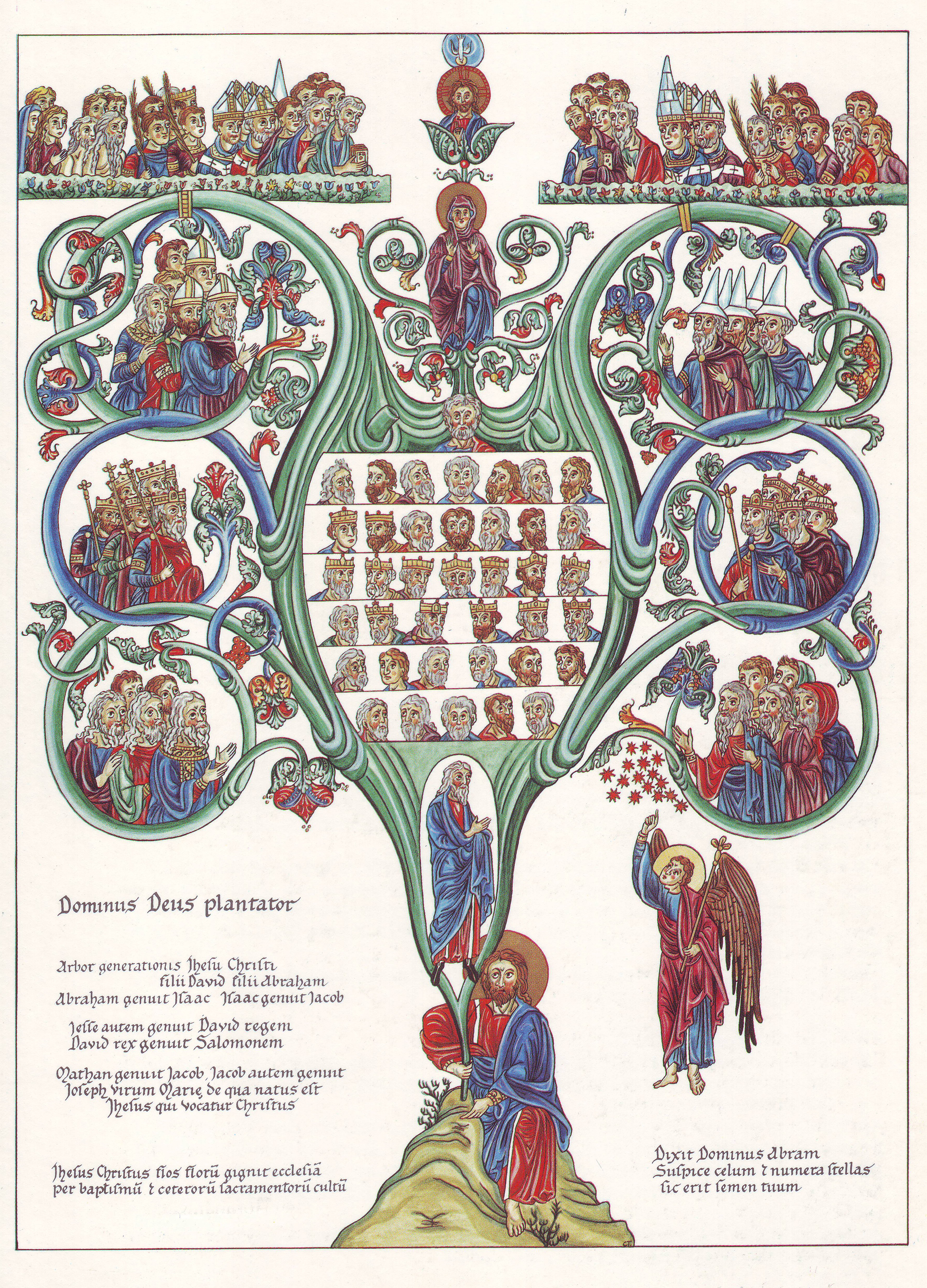
This is a pictorial genealogy. As far as I can tell, the women are only shown in the top left corner. (link)

 Second, as far as Matthew mentions, the only visitors who come to honor the baby King were some travelers from far to the East looking for a king. They knew instantly who to worship when they entered his room. How striking for a King who went unnoticed by "His own"...


 Interestingly, Luke (the Greek) has a much more Jewish-oriented account of the birth of Christ, though he does not neglect the universal call of the Savior.

27 August 2016

Roaring Waters (Åžile) & Robed Majesty (on High)


  I may blog some highlights from our time visiting Åžile with family. However, the waves provided insight into  passages of Scripture which have never stood out to me before: the ones about the roaring of waters and the charcter of God. Then, I 'stumbled upon' the psalm below. I'll include my two observations as captions for the pictures.

The roar of the waves is constant and unfading, only our consciousness of it fades.

            The LORD reigns; he is robed in majesty;
                        the LORD is robed; he has put on strength as his belt.
            Yes, the world is established; it shall never be moved.
            Your throne is established from of old;
                        you are from everlasting.
           
            The floods have lifted up, O LORD,
                        the floods have lifted up their voice;
                        the floods lift up their roaring.
            Mightier than the thunders of many waters,
                        mightier than the waves of the sea,
                        the LORD on high is mighty!
           
            Your decrees are very trustworthy;
                        holiness befits your house,
                        O LORD, forevermore.

                       (Psalm 93 ESV, emphasis added)

Before the roar of the waters, minor sounds fade or disappear.