...observations and ramblings from a learner and traveler...

Showing posts with label Revelation. Show all posts

25 August 2024

Trabzon, Rize, Batumi (Georgia) - a celebratory trip with friends

  I'm close to turning 40, and since I didn't want a big party, my wife suggested that I take a trip with close friends and celebrate that way. So we did. We visited Trabzon, Rize, and Batumi. Sumela Monastery was definitely a highlight of the trip. Excellent food was also important. Most important was the fellowship of friendship which allowed us to share things temporal and eternal.

SUMELA MONASTERY and its environs

The view from the trail to the monastery

Outside the entry to the monastery

The monastery buildings

View from a distance (by the church)

Melchizedek and Abram fresco


St. George and the Dragon (I think)

The walls were covered with the biblical narrative, starting with the creation at the top. The monastery seems to have functioned as a school of biblical training to some extent. The frescoes do not seem to be standard icons, to my uneducated eye.

More of the biblical narrative in frescoes
The view from the parking lot. Technically you can walk to the monastery from there, but it was apparently 4 kilometers, most of which was at a steep angle. We paid the $1.50 to ride the bus; the driver kept it interesting.
A stream near the parking lot

TRABZON

The view from a beautiful breakfast restaurant

Gravestone headpiece explanations for Ottoman-era tombstones, which often include the headgear of the deceased on top to indicate the deceased social status

The seraphim and the four beasts around the Throne. This is the central ceiling fresco in Trabzon's Hagia Sofia church building, converted to a mosque, converted to a museum, now converted to a mosque again.

Historically the four beasts before the Throne are linked to the four gospel accounts (Matthew with the man, Luke with the bull, John with the eagle, and Mark with the lion.) 

Jesus teaching at the Temple as a youth

exterior of the Hagia Sofia (Trabzon)

column designs still fascinate me 2 decades after World History 101

The Last Supper fresco - the use and non-use of halos was interesting to me.

Christ as Judge (Pantokrator)

Trabzon city walls / fortress

Trabzon city walls / fortress from a distance


RIZE
 
Rize panorama

Rize at night, notice the massive tea cup on the left


BATUMI
 
Georgian side of the border

delicious Georgian food

 Panorama of Batumi


The Grand Gloria Hotel looked very impressive, at least from the outside.

a small, quite new church building by the border

10 October 2023

The Drier of Tears


    And [the Lord of hosts] will swallow up on this mountain
        the covering that is cast over all peoples,
        the veil that is spread over all nations.
    He will swallow up death forever;
    and the Lord GOD will wipe away tears from all faces,
        and the reproach of his people he will take away from all the earth,
        for the LORD has spoken. (
Isaiah 25:7–8, ESV)

The exalted title the Sovereign LORD calls attention to the fact that in all the dignity of his divine sovereignty, it is the Lord himself who will attend to our tears, moving from person to person until each eye has been dried. On the disgrace of his people cf. Joshua 5:9 where the rite of circumcision was renewed for the Lord’s people. It symbolized that the days of covenant abeyance were over and that the ‘disgrace of Egypt’ was gone – the disgrace to the Lord’s people of living in slavery, bondage and misery. So also, as long as life in this world endures, there are innumerable ways in which the people of God are under reproach and hindered, by circumstances and sin, from living according to their true dignity. All this will be taken away. The new nature will be given full and glorious expression in an environment where everything conduces to holiness (cf. Phil. 3:20–21). Covenant promise will have become covenant reality.(Motyer, 210, Kindle) 

 ‘The Drier of Tears’, of course, brings the Psalmist’s bottled tears to mind as well as the more well-known reflections of this passage in John’s Revelation. Imagine a loving parent as they comfort a child and wipe away the tears of their hurt child. They do not deny the pain, but they comfort and enter into it. They encourage the child with reasons that things will end okay and that the pain will not conquer. This Sovereign’s attentions are not the ‘be tough’ shushing of an impatient or distant parent to a child genuinely in pain, nor does the Sovereign unnecessarily comfort an emotional or manipulative outburst. 

 Instead the image given here is the Sovereign Lord squatting down before each child taking them in turn and re-opening all those bottled tears which have been stored up, not to re-live the pain but to engage its reality with empathy and bring resolution and full healing. Waiting with each tear till it has been dried, the Sovereign Lord stills and heals the heartbreak of all of His own: each loss, each grief, each pain, each betrayal, every agony of birthing, all the reproach which has been heaped on the child publicly or privately whether by themselves or others, each unfulfilled longing, every scarcely understandable cry of rage, each pang of guilt and insufficiency, every moment of teeth-gritting or of grinning-and-bearing-it, all the despair and disillusionment, in short, all the groaning and mourning and suffering which had been brought on by the curses in this cosmos. All of these heartcries will be engaged, even authenticated, and defanged by the One who values what may have, until that moment, been unseen and unacknowledged by any other in the universe. 

  Within this context, the sorrows of judgment must be mentioned; the tears which were mourned in the Lord’s comprehensive judgment of chapter 24 will also be dried. This One pauses for each tear till the heart that has held it is clear, the eye that it trickled from is dried. At that moment, nothing will be more important than these hurts and this healing. This is a key piece of the great salvation, and it will not be denied! Isaiah insists upon this point (Isa 30:19; 35:10; 51:11; 65:19). May hope in the Drier of Tears, who is also the Remove of Reproach, steady our hearts.

NOTE: There is no destruction of the human emotional capacity here; this is a making well of heartache. In the context (notice Isaiah 26), there is a full range of emotions during and following the ‘healing of sorrows.’ This is about healing and wellness, not simply or superficially about tears; tears are foregrounded as the powerful symbol summarizing the need for comprehensive healing. So, it is about tears; they are vitally important, but they are not ultimate, they will pass at the right time.

09 March 2023

Dogs in the Bible

  Yesterday evening in our small group Bible study, a couple of us were interested in this reference: "But not a dog shall growl against any of the people of Israel, either man or beast, that you may know that the LORD makes a distinction between Egypt and Israel." It's in the context of the angel of death who is going to execute the firstborn sons throughout Egypt, and it is of rather minor theological significance. However, in a culture which loves puppies, it is interesting: this appears to be the first reference to dogs in Scripture.

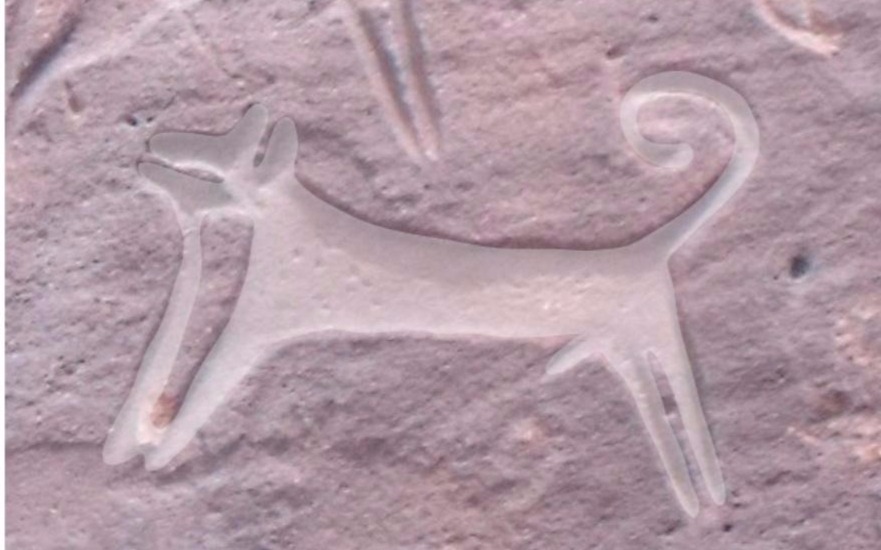
ancient hunting dog art

 So, how are canines mentioned in the Bible? Well, honestly, the references to dogs don't seem particularly different from today.

"Pets" (domesticated or household dogs)

- Exodus 22:31; Matthew 15:26-27 & Mark 7:27-28 (food thrown to dogs)

- Job 30:1 (sheep dogs)

- Psalm 68:23 - 'the tongues of your dogs may have their portion from the foe' - sounds like guard dogs

- Isaiah 56:10-11 - watchdogs

Name-calling or Self-deprecating humility

 - 1 Samuel 17:43; 24:14; 2 Samuel 9:8; 16:9; 2 Kings 8:13; Psalm 22:20; Philippians 3:2; Revelation 22:15

Packs of Dogs

- The above Exodus 11:7 reference seems to be concerned with possible violence from a dog. It could be a watchdog, but it seems more likely to refer to packs of dogs in light of some of the later references. Other references in this category would include 1 Kings 14:11; 16:4; 21:19, 23-24; 22:38; 2 Kings 9:10, 36; Psalms 22:16; 59:6, 14; Jeremiah 15:3

As dirty animals or animals with dirty or inappropriate-for-a-human habits

- Judges 7:5 - "a dog laps"

- Proverbs 26:11; 2 Peter 2:22 - "A dog returns to its vomit"

- Matthew 7:6 - "do not give dogs what is holy"

Unclear or Random 

- Deuteronomy 23:18 - "wages of a dog" - maybe a dog loaned out for hunting purposes???

- Proverbs 26:17 - "a passing dog"

- Ecclesiastes 9:4 - "a living dog is better than a dead lion" - maybe for guarding???

- Luke 16:21 - dogs licking sores - this could be seen as sympathetic and healing, or a sign of misery; the dogs could be from the household or a pack potentially ???


**Prov 30:31 mentions an animal which is unclear for translation ("girt of loins"), possibly a greyhound or a strutting rooster.

ancient dog carving from Saudi Arabia

25 April 2021

A White Stone, with a Secret Name

Photo by Who’s Denilo ?

  In my recent reading of Adorning the Dark, a passage from this old 'unspoken' sermon on 'The New Name' by George MacDonald was mentioned. I've included some excerpts below. While there are many places in the Scriptures where the communal or corporate identities of God's followers are emphasized, the particular verse in this sermon is strikingly focused on the individual. It is sourced in the promise of Jesus:

To the one who conquers I will give some of the hidden manna, and I will give him a white stone, with a new name written on the stone that no one knows except the one who receives it.’ 
Revelation 2:17b

Photo by Edgar Soto

The true name is one which expresses the character, the nature, the being, the meaning of the person who bears it. It is the man's own symbol,--his soul's picture, in a word,--the sign which belongs to him and to no one else. Who can give a man this, his own name? God alone.
...

God's name for a man must then be the expression in a mystical word--a word of that language which all who have overcome understand--of his own idea of the man, that being whom he had in his thought when he began to make the child, and whom he kept in his thought through the long process of creation that went to realize the idea. To tell the name is to seal the success--to say, "In thee also I am well pleased."
...

To him who climbs on the stair of all his God-born efforts and God-given victories up to the height of his being--that of looking face to face upon his ideal self in the bosom of the Father--God's him, realized in him through the Father's love in the Elder Brother's devotion--to him God gives the new name written.
...

But I leave this, because that which follows embraces and intensifies this individuality of relation in a fuller development of the truth. For the name is one "which no man knoweth saving he that receiveth it." Not only then has each man his individual relation to God, but each man has his peculiar relation to God. He is to God a peculiar being, made after his own fashion, and that of no one else; for when he is perfected he shall receive the new name which no one else can understand. Hence he can worship God as no man else can worship him,-- can understand God as no man else can understand him. This or that man may understand God more, may understand God better than he, but no other man can understand God as he understands him. God give me grace to be humble before thee, my brother, that I drag not my simulacrum of thee before the judgment-seat of the unjust judge, but look up to thyself for what revelation of God thou and no one else canst give. As the fir-tree lifts up itself with a far different need from the need of the palm-tree, so does each man stand before God, and lift up a different humanity to the common Father. And for each God has a different response. With every man he has a secret--the secret of the new name. In every man there is a loneliness, an inner chamber of peculiar life into which God only can enter. I say not it is the innermost chamber--but a chamber into which no brother, nay, no sister can come.

From this it follows that there is a chamber also--(O God, humble and accept my speech)--a chamber in God himself, into which none can enter but the one, the individual, the peculiar man,--out of which chamber that man has to bring revelation and strength for his brethren. This is that for which he was made--to reveal the secret things of the Father.

...

And what an end lies before us! To have a consciousness of our own ideal being flashed into us from the thought of God! Surely for this may well give way all our paltry self-consciousnesses, our self-admirations and self-worships! Surely to know what he thinks about us will pale out of our souls all our thoughts about ourselves! and we may well hold them loosely now, and be ready to let them go.
...

[Application:]
Ambition is the desire to be above one's neighbour; and here there is no possibility of comparison with one's neighbour: no one knows what the white stone contains except the man who receives it. Here is room for endless aspiration towards the unseen ideal; none for ambition. Ambition would only be higher than others; aspiration would be high. Relative worth is not only unknown--to the children of the kingdom it is unknowable.

Photo by bantersnaps


26 August 2019

Patmos - the island

  Shortly after we got married, Bethany told me that we needed to start saving so that we could "do something special" for our 10th anniversary.  Since we were barely making ends meet at the time, this seemed like an odd thing to save money for, to me.  However, she was certainly right, and we started it with a few dollars. Last week, a decade of saving came together, and we got to go on a cruise in the (nearby) Greek islands! We flew to Izmir and got on the ship, and a few hours later, we were at our first stop, the island of Patmos. 

The harbor at Patmos
  My recollection of how Patmos is described in biblical commentaries on the book of Revelation is "a small rocky island"... not that I could give a specific reference for that. That description is not particularly wrong, although the island is quite a bit bigger than I envisioned. It's small for an island, but it's not particularly small.

Harbor picture 2
  There was a tour that showed various historical (or supposedly historical?) sites on the island, but we preferred to just walk around the town and observe it from various perspectives. We also enjoyed some excellent ice cream there and bought some pistachio-chocolate sauce (imagine dark chocolate Nutella, made with pistachios!)


The town on Patmos

Sunset over Patmos harbor

the sun disappearing


06 June 2019

How many prophetesses are there in Scripture?

 A while back in my office - it was probably around International Women's Day, the discussion arose about prophetesses and whether the Bible recorded any. The colleague I was talking to is a well-informed Muslim although she's not specifically trained in theology. She didn't remember any being mentioned in the Kuran although she thought it was reasonable to assume that some of the thousands of prophetic messengers that are referenced in the Kuran were women.

  It seems likely to me that if one accepts both the speaking 'messenger' and speaking-writing 'prophet' within Islam as "prophets," it's quite likely that Eve, Mary the mother of Jesus, and other women could be considered prophets according to Islam. However, an internet search quickly shows that this is a disputed opinion, and it is certainly not one that I have the expertise to speak about.

  Anyways, for the student of the Torah, Psalms, Prophetic and Gospel writings, it is certainly clear that there were prophetesses. In fact, they are listed throughout Scripture. So, a pop quiz:

How many prophetesses are named in the Bible? Who are they?

  Who is the one in the Torah? Who are the two in the historical writings? Who is the one in the prophetic writings? Who is the one in the Gospel writings about Jesus? Who are the ones in the earliest church?

  Miriam, the sister of Aaron and Moses - Exodus 15:20 - It is not mentioned whether she married or not in the Scripture themselves. Some tradition suggests she was.
  Deborah - Judges 4-5 - Her husband is mentioned, but children are not.
  Huldah - 2 Kings 22:14; 2 Chronicles 34:22 - Her husband is mentioned though children are not.
  _?????_, unnamed wife of Isaiah - Isaiah 8:3 - Her husband was also a prophet; she had at least two sons. (Some suggest she may simply be being referred to as "the prophet's wife" in this passage, but many argue against this.)
  Anna - Luke 2:36 - She had been married, but had been widowed for a long time when she sees Jesus and is mentioned as a prophetess. (related post on "The Odd Notion of 400 Silence Years")
  The 4 Daughters of Philip - Acts 21:9 - These daughters are specifically mentioned as being unmarried at the time when they met Paul and Luke.

  Each of these prophetesses, as well as the additional women and passages below, could be considered in a lot more detail in order to develop a thorough understanding of this area. The people and priests and kings of Israel would all come to these prophetesses to consult them about the word of the LORD. Personally, I wanted to have a clear answer to the question, but the answer will always depend on the phrasing of the questions. How many prophetesses of the Lord are NAMED in Scripture? 4 along with others who like many prophets in Israel remained unnamed. How many prophetesses of the Lord are mentioned in Scripture? 8. 

Additional tidbits and relevant Scriptures:
  Joel 2:28-29; Acts 2:17-18 [cf 1:15; 2:1-4]; 1 Corinthians 11:5

  Two women are mentioned as false prophetesses as well, Noadiah (Nehemiah 6:14) and Jezebel (Revelation 2:20). In the second case, the name might be figurative.

  The Jewish Talmud (rabbis' discussions of the Scriptures) lists seven Jewish prophetesses: Sarah, Miriam, Deborah, Hannah, Abigail, Huldah, and Esther. (Megillah 14a) It is also gives the reasons each is considered a prophetess. It is interesting that the Talmud does not include Isaiah's wife.

12 February 2011

Christ-centered Christianity - a guest post

As simply as I can state it, my question is: Is Gospel-centered Christianity a subtle deviation from Christ-centered Christianity, making Christ preeminent in everything?

Now, I know that it is impossible and probably undesirable to seek to draw a clear distinction between Christ and His cross-work, but there is a difference. One is who He is—Himself—and the other is what He does/has done—His ways/work. Obviously, His work flows from who He is and is a perfect expression of Who He is. The major point of the work, then, is to reveal Him to us. That means we have to accept and embrace what He has done for us, and due to the nature of salvation and how the cross changes everything, we are rightly overwhelmed and fascinated by the Gospel. What is the Gospel? It is the story of Jesus, the Good News of His redemption and His provision for reconciliation between holy Creator God and rebellious, damned created humans. As the song says, “This is the best news that we could ever hear. More than amazing, it drives out every fear. By trusting in Jesus Christ, in His saving sacrifice, we can be made new.” If we are focused supremely on His work, however, we may never actually follow through to the end that His work intended us to reach: knowing Him, seeing Him, being fascinated with Him, gazing on His face, fellowshiping with Him personally, understanding and glorying in Him. Due to the nature and message of the Gospel, this should never ever happen. But it does.


What does that look like? Well, look around. In a growing, healthy church these days, a growing number people have grasped/are beginning to grasp the earth-shaking significance of the Gospel for everyday life. You hear them. They talk about it. They discuss it theologically and even spin out some of its implications. In fact, they talk about it a lot—especially in specific settings like church… or Bible study… or even with a fellow-believer on occasion. “Spreading the Gospel.” “Preaching the Gospel to myself.” “Living out the Gospel.” Nice phrases (not being sarcastic here!) that we hear a good bit these days, and I am glad of that. I use those phrases, or very similar ones, myself. But then check out the rest of the conversation and look at some of the life choices—not even the “sinful” ones necessarily. Look at the way leisure time is spent, the entertainment choices, the financial commitments, the casual/careless speech, and the personal preferences and delights. Is there a disconnect? (I realize no one is perfect and/or completely consistent.) Usually, the answer is “Yes.” Do they mean to be inconsistent? Usually the answer is “No.” After all, these are people that are striving to be Gospel-centered. When they say they love the Gospel and are committed to living it out, they truly mean it. So why don’t their lives look like little suburbs of Heaven? (Again, not envisioning perfection, but seeking something that matches Scripture’s portrait of how God’s people should live.) There is a disconnect. Due to the nature and message of the Gospel, this should never ever happen. But it does. 

Why? “Gospel” is inherently a “thing” word. The Gospel is a story, a set of facts—a story about a Person, a set of facts about a Person—but not the Person. Gospel and Christ/God are inextricably linked, but they are not interchangeable. (It is the "power of God"...) “God is the Gospel” is not the same as “the Gospel is God.” The Gospel is not the Person, and Christianity is about a Person, not about a story about a Person. (I really hope this does not sound like I am engaging in purposeless, endless semantics.) If the Gospel does not lead you to the Person, you have missed the whole point of the Gospel. When I say “lead you to the Person,” I do not mean that in your examining the Gospel, you occasionally (or even frequently) express your gratitude to God for all that He has done for you through the Gospel. I do not mean that you do not acknowledge the mercy, grace, and love of God so brilliantly displayed at the cross, or that you completely ignore the blazing power of the resurrection. But, you can process all those as part of the “story” without ever allowing them to impact your functional view of God. You can gaze at the Gospel and never quite get around to gazing at Christ and being transformed by the Spirit into the image of Christ. Due to the nature and message of the Gospel, this should never ever happen. But it does.


How does this happen? I suggest that Gospel-centered Christianity is a subtle misuse of the Gospel. Let me illustrate with two word pictures:

1.  The Gospel is a bridge. It is the bridge that Christ built to provide access to Himself and to His Father. You cannot get to God without the Gospel. (Right now, I am not speaking of the salvific sense either. I am speaking of the Gospel as it relates to the believer’s life.) Perhaps it would be slightly more accurate to say that, even as a believer, you will not get to God without the Gospel. You will not get to God without the Gospel because you will be so overwhelmed by your sin, by your slowness to grow, by your lacking performance, by your fears, etc., that guilt and discouragement will cripple you, and you will be, for all intents and purposes, estranged from God. You will lapse back into being afraid of Him, trying to hide from Him, striving to manipulate Him, attempting to appease Him and weasel your way into His favor somehow. Unless you go to the Gospel, you will not get back to God. The Gospel reminds you of what Christ did for you and how what He did gives you perpetual and immediate access to God without fear. It reminds you that your performance has never been the grounds of God’s acceptance of you. It bids you run to God now, just as you did when you first turned from your sin to worship and serve the true and living God. And so you run across the Gospel bridge and throw yourself in the arms of God and stay there, talking with Him, learning from Him, looking at His face, worshiping Him, obeying Him….until you either intentionally or carelessly wander off and find yourself isolated by your sin, having chosen to allow sin to be your master again, though Christ broke sin’s tyranny over you. You long for fellowship with God again, and the Spirit reminds you of the Gospel. In His strength, you run across the Gospel bridge (we might call this preaching the Gospel to ourselves) and back into our dwelling place in God through Christ. The Gospel is the bridge. It is indispensable. It is glorious. It is beautiful. It is an incomprehensible display of the wisdom of God, the love of God, the wrath of God, the righteousness of God, the mercy of God, and much much more. But do not build your house on the bridge. The bridge manifests the character of God in order to point you to God Himself. If you settle down on the bridge instead of actually crossing all the way over and finding your home in God, I think you are misusing the bridge. The Gospel is not the center of the Kingdom; the One sitting on the throne is the center of the Kingdom, the center of life and Life.


2. The Gospel is a beautiful glass window in an otherwise wretched dungeon, a dark, filthy, stench-filled torture-chamber (again, not in the salvific sense, but in the believer’s experience). You can be fascinated by the glass window itself—its beauty, clarity, light-giving properties and so on, or you can look through it and see the sun and the trees and throw it open and climb out of your prison cell back into freedom.


Analogy: From cover to cover, the Bible tells us of God’s relationship with people, and, barring the first two chapters of Genesis and last two chapters of Revelation, His relationship with a sinful, rebellious people in need of redemption. The only reason there is a need for redemption is because God loved sinful man. No sin = no redemption story. So, in a sense, the Bible is about us and our being redeemed. But we know that in a much greater sense, the Bible is about God. It is about Who He is and what He is doing and how everything from eternity past through eternity future is working together to bring Him glory, the glory due to His Name. We can read the Bible as a revelation about us and find some really large, really relevant truth in that. Or we can read the Bible as a revelation of God and practically explode our minds by the little glimpses that we see into the Infinite One and eternity. So we can read the Bible from two different perspectives—both acceptable, though not equally weighty—and get two different results from our reading—both profitable, though not equally magnificent.


The Gospel is kind of like that. You can view the Gospel as the truth about Jesus and His work on your behalf that saves you and enables you to live by grace instead of trying to keep the law and living under guilt and fear, and you can truly and legitimately derive profit and joy from seeing the Gospel like that. You can also view the Gospel as the truth about Jesus, the Savior who saves you  and gives access to God both now and forever, and you can go on to take full advantage of that access to God by living in His presence day and night and knowing Him and admiring Him and growing in your understanding of Him and being transformed by His Spirit into His likeness.


I think that our common application of “Gospel-centered Christianity” leaves us sitting on the bridge, admiring the magnificent window, and content to escape living a guilt-laden life because we have tapped into grace. Due to the nature and message of the Gospel, this should never ever happen. But it does. That is why I think we are missing something… something really essential. Hence the question: Is Gospel-centered Christianity a subtle deviation from Christ-centered Christianity: making Christ preeminent in everything, being His disciple, knowing Him and making Him known?

**This is a guest post by Miriam K. Champlin, slightly edited with her permission.

31 October 2010

The Priesthood of Believers

  Having grown up as a Baptist, I have long been familiar with both the concept and the term “priesthood of the believer.” However, it was not until I was reading about Martin Luther’s conception of that doctrine in the last few days that I really gave it much thought, from a biblical perspective. I’ve always just considered it to be one of the “Baptist distinctives.”

   According to Justo González in The Story of Christianity, Luther’s understanding of the priesthood of believers was as follows:

“While it is true that all Christians, by virtue of their baptism, are priests, this does not mean—as some later interpreters have said—that one is self-sufficient to approach God for oneself. There is a direct communion with God that all Christians can and should enjoy. But there is also an organic reality within which all communion with God takes place, and that reality is the church. To be priests does not mean primarily that we are our own individual priests, but rather that we are priests for the entire community of belief, and that they are priests for us. Rather than setting aside the need for the community of the church, the doctrine of universal priesthood of the believer strengthens it.” (Vol. 2, pg. 33)
   The thing that immediately struck me about this view of the doctrine was that this was almost exactly the opposite of what I had understood the doctrine to mean: I thought it meant “I can go to God for myself.” And yet, that is not the role of a priest! A priest goes to God for others. So, I started looking at the various biblical passages that speak of the priesthood of believers. Two things are apparent from the passages that talk about believers' priesthood (1 Peter 2:5, 9; Revelation 1:6; 5:10; 20:6). The first is that Luther's community focus of the doctrine is correct: the passages speak of the Church as a priesthood and believers as priests, but they do not individualize the doctrine. So, while the individual believer is a priest, to emphasize that is to miss the point. The second conclusion is that a major function of all priests is to offer sacrifices, and this is made evident in most of the deeper teaching that I found. A practical consequence of this is that believers should be seeking to understand what sacrifices God expects of them.

   So, why have Baptists considered this one of their distinctive doctrines when virtually all Protestants hold to these conclusions? As far as I can tell, the major way in which this doctrine is applied for Baptists is in the defense of congregational church government. The argument is as follows, “Because all believers are priests with access to and communion with God, they are all competent to help lead the church (though some are more competent than others).” While I believe in a form of congregationalism, I am no longer certain that the above argument is valid at all. In fact, I think that is probably a damaging twist on a vital doctrine. If this doctrine is to support congregationalism at all, it should be said that as the community of believers approach God on each other’s behalf, seeking divine wisdom and grace, they may expect to receive such wisdom and grace as a community of God-ordained mediators.

  Please do not simply co-opt this doctrine to further the Western cultural values of individualism and democracy; rather love the doctrine for its biblical truth!  Let us learn to live as a holy and royal priesthood, mediating for our fellow believers and offering acceptable sacrifices to our God.  For we have a High Priest who mediates for us and has offered the Acceptable Sacrifice which allows us access with confidence to the our beloved Father's Throne of Grace.

17 April 2009

Meditations from the Second Psalm

This semester I have been taking a class on Revelation; Psalm 2 applies immediately to the time period dealt with in that book. Read in the context of the last days...

Meditations on the Second Psalm
 4/17/09

Why do the nations rage,
and the peoples plot in vain?
The rulers of men take counsel together
to remove the Lord's restraint.

Behold!
The Lord's Anointed cometh!

The Lord in heaven laughs;
and God derides their plans.
The words of the Lord strike dreadful terror,
"The King sits as appointed."

Behold!
The Lord's Messiah cometh!

The Lord's decree unveiled:
A Son He has begotten,
Who owns the world and rules the nations
judging, breaking at will.

Behold!
The Lord's Christ Jesus cometh!

And now, beware! Serve God,
with joyfulness and trembling.
Reverence the Son and quell His wrath
Blessed are those He loves!

Behold!
The Lord's Anointed cometh!

24 June 2008

Sardis, Thyatira, Philadelphia, Smyrna

The Mountains, the buildings, the Bethany - at Sardis

So, what is left at some of the less famous cities of the 7 churches? Well in some cases, we might not have known what was there in the first place. Sardis was once the capital of the kingdom of Lydia, where coins are believed to have first been used. But now in Sardis there are mostly Roman ruins, with the rebuilt entrance to the old gymnasium being the most impressive building. However, there are also impressive ruins from a Jewish synagogue with some well-preserved mosaics adorning the floor.

Rebuilt entrance to the Sardis gymnasium

At the site of ancient Philadelphia, the city of AlaÅŸehir now bustles. There is remarkably little to indicate that an old city is buried beneath the ruins of the modern one. (And I don't currently have a picture from there.)
Ruins at Thyatira
The ruins at Thyatira (modern Akhisar) are also sparse, although slightly more plentiful. This is the city where Lydia (whom Paul met in Philippi) was from. She was a seller of purple/indigo, which is quite natural since Thyatira was know for its dyeing and indigo trade.

Bethany & I at Thyatira... resting on a random fallen column

The final city that we saw on this particular day was ancient Smyrna/modern Izmir. Here part of the ancient agora has been restored, and it is quite interesting since it is actually a two-story marketplace. That is why in the picture below we are looking down on the arches of the first level. There isn't much of the ancient to see here either.
Arches of ancient agora in Smyrna/Izmir


What came to mind while we saw these cities? These places brought to more reality the fact that by the time John penned the Revelation most of the churches in this area were under some form of persecution. The message to each of these churches was "Hold fast; be faithful." And as with those churches that were receiving the completion of the canon, if we are faithful to what is written in the Word, we will have done all that is required.


Related posts: Seven Churches Intro and MiletusColossae, Laodecia, HierapolisPergamumprevious trip to Hierapolisprevious trip to Ephesustrip to Cappodocia

18 June 2008

Seven Churches Tour: Introduction and Part 1, Miletus

Introduction: Having now returned from the tour of the seven churches of Revelation and other Turkish historical sites, I think I will try to give you all an extended update. The point will be to share pictures/information about these sites in a helpful way. However, some of the pictures that I would like to use are "unavailable" since Bethany and I usually only took one of our cameras along. Thus, I only have pictures of some of the sites, so I may try to post those other pictures later.

The Main Street in Ephesus
Miletus/some Ephesus: Last Thursday morning, our tour group traveled down to the site of Miletus. Miletus was the place where Paul said goodbye to the Ephesian elders in Acts 20. Portions of the ancient harbor, the agora, the theater, and other areas of the city have been preserved.
But notice that Paul "touched at Samos" immediately before he got to Miletus (20:15). Samos is a large island that is a little ways out in the Aegean Sea. This is interesting because beyond Samos is the island of Patmos. To get from Ephesus to Patmos, one would simply have sailed the relatively short distance... probably an easy one-day trip.
Now think of John's exile at Patmos, and remember that according to very strong legend, John had previously been the pastor at Ephesus. Thus, when John writes to the church at Ephesus and says that they have left their first love, it is the voice of their pastor who is suffering persecution "just over the horizon." It is not as if he had been taken to Rome or somewhere far off. He was still faithful to his first love, but they had drifted. The geography personalized John's words a bit more when this was pointed out.

I will probably not add more about our visit to Ephesus, because of the overlap. For thoughts and pictures of that, visit here.

Related posts: Sardis, Thyatira, Philadelphia, SmyrnaColossae, Laodecia, HierapolisPergamumprevious trip to Hierapolisprevious trip to Ephesustrip to Cappodocia

11 June 2008

Off and away

In approximately 6 hours I am to get under way, headed to what should be my last major (planned) adventure of my time here in Turkey this year. I am joining a student group that is traveling down to Ephesus and seeing many of the major tourist sites between here and there on a 6-day trip. The sites should include the 7 cities of Revelation, the Gallipoli peninsula, and other places of historic/natural interest. I actually saw a couple of these sites already on my trip in December, but maybe that will just allow me to get a better understanding of what else is around.

Unfortunately I really don't have time for an extended post. I just finished Francis Schaeffer's trilogy yesterday; it has been good to read his Christian philosophy as I study various of the historic philosophers. Towards the end of He is There and He is not Silent, Schaeffer says that because Christians have an understanding of what is "really" there (as opposed to wondering if anything is actually there) and because we believe that man is made in the image of the creative God, we should have fertile imaginations. Some of his thoughts in this connection would be interesting to talk about in light of recent discussions of fantasy, whether that be Rowling's Harry Potter or Lewis's Narnia. Why has fantasy and fiction so often been a great tool of Christian thought? Why is it often so corrupt a form of communication? What makes for good, profitable fictional writing or speaking?

I think some of the answers to these questions are suggested in Schaeffer's book, though he does not deal explicitly with them here. But the questions are good to ponder. Till later...

22 August 2006

Music Discussion, Part 2: The Other Passages

Having considered some foundational passages on music, let's consider the other New Testament passages that deal with singing.

1 Corinthians 14:15 - What is it then? I will pray with the spirit, and I will pray with the understanding also: I will sing with the spirit, and I will sing with the understanding also.
- The emphasis in this passage is that not only should praying and singing edify the individual doing it, but when done in public it should also edify the church.
- There is a somewhat mystical element to singing and prayer, which relates to worshiping God. This should be balanced with the fact that there should be a public edification and understanding of what is going on.

1 Corinthians 14:26 - How is it then, brethren? when ye come together, every one of you hath a psalm, hath a doctrine, hath a tongue, hath a revelation, hath an interpretation. Let all things be done unto edifying.
- This passage indicates two things.
o All congregational activity including singing is to build up the believer. (vs. 26)
o All congregational activity should be done orderly. This is derived from the context, for this section of chapter 14 is dealing with an orderly meeting of believers (vs. 27-33, 40). (This is not referring to having “orderly music” that follows pre-arranged rhythmic patterns or so forth, rather it refers to not having an orderly service, not having different people singing different songs at the same time.)

Matthew 26:30 & Mark 14:26 - And when they had sung an hymn, they went out into the mount of Olives.
- These passages simply refers to the fact that Jesus and the disciples sang a hymn after the institution of the Lord’s Supper and before they went to Gethsemane. This may lend support to using music in the Church, but it doesn’t seem particularly significant otherwise (or maybe I’m missing something; that’s always possible).

Acts 16:25 - And at midnight Paul and Silas prayed, and sang praises unto God: and the prisoners heard them.
- This passage does not refer specifically to music in the church. Rather, it applies to our discussion in that it shows the spirit which our song should exhibit. We should have a song of joy in our hearts which must praise God regardless of circumstance. And this ties in perfectly with the final passage.

James 5:13 - Is any among you afflicted? let him pray. Is any merry? let him sing psalms.
- This passage gives us the source of our song: the joy of the Lord. Singing should be an overflow of our joy. This ties directly to the fact that singing should flow from a Word-filled, Spirit-filled, life; the intertwinedness of Scripture is fascinating.

Throughout the Old Testament, it seems that singing was used primarily as a means of ministering to the Lord by praising His name (or to heathen gods in their context). It does not appear to have the same expected purpose of horizontal ministry attached to it.  The Psalms give a vast array of instructions for how to praise God with music.

Throughout Revelation, singing is used to praise God for all He has done and is doing. In eternity, the only purpose of singing will likely be to praise God, for there will not be the same need of edification.

CONCLUSION: The dual purpose of singing appears to be that of praising and worshiping God and edifying those around us through teaching and admonishing them in truth. Thus, there should be Word- and Spirit-filling on the part of the singer, as well as understanding on the part of both the singer and the listener. Our singing should come from the joy of the Lord which has filled our hearts; often it will be a sign of our trust in God. My final thought/challenge is that if we were more fully controlled by the Spirit, we might not have so many problems with music in our churches (or homes).