I need a day informed by eternity, eternity in the minutiae. The vastness of the universe and the expanse of eternity have to provide either tremendous significance or extreme insignificance to the human experience of hours and days and decades. And this is exactly the choice we face in the birth-incarnation of Jesus, called Immanuel ('God with us'): is eternity a sign of hope or of despair to us? Does the universe speak of nothingness or of the Transcendent? Are we statistically-induced specks or treasured creatures in a bountiful Creator's expression of majesty?
(image from Shutterstock)
20 December 2015
Eternity in the Minutiae


06 December 2015
Intervening in God's Judgment - Psalm 106
Psalm 106 is a recital of the LORD's dealing with His covenant people, and it is a celebration of His steadfast covenant love towards them. Part of the relationship between the LORD and His people is the actions of the people. Psalm 106 explores this relationship in depth, starting with the blessedness of living as a righteous person who does justice (vs 3). Yet by verse 6, the Psalmist acknowledges that the Lord's chosen ones have sinned and committed iniquity and wickedness. As he goes on to recount some of the rebellion of God's chosen ones, he also recounts different ways in which this rebellion was dealt with.
The LORD's first response comes in verse 8 where He saves the people He chose from their rebellion by the sea 'for his name's sake, that he might make known his mighty power.'
In verse 15, the LORD's second response is to send the people the thing they were begging for in their disregard for Him and to unleash judgment on them. Judgment follows again in verses 17-18.
But in verse 23, after the people's most egregious breach of faith, the LORD speaks of destroying His own people, yet in response to Moses' pleading for the people, His judgment is turned away. This happens again in verse 30, where Phineas intervenes, and God spares the people further judgment. (Verse 31 notes that this was counted to Phineas as righteousness, just like Abraham!)
In verses 32-33, an account is mentioned where Moses failed to intercede for the people because he himself was angered in sin.
The final verses list accounts both of deliverance and judgment, specially focusing on God's steadfast love and His remembrance of His covenant.
The thing that draws my attention here is the subplot, the part a couple individuals played in the grand narrative of God's mercy to an imperfect people. Moses and Phineas are allowed by God to act as true priests, standing between the great God and a sinful, rebellious people and pleading with God to have mercy on them. About Moses this is described as standing in the gap to turn away the Lord's wrath from destroying them. About Phineas, it is described as standing up and intervening. Strikingly, in verse 47, we find the psalmist himself begging for the LORD God's mercy on His people, too.
This subtheme in the psalm is reminiscent of other passages where the righteous, but imperfect, believers act as priests for those living unrighteously. Abraham priests for Lot and Sodom and Gomorrah. Ezekiel speaks of similar roles for the godly; in 22:30, he speaks of 'standing in the breach' like Psalm 106, as well as in 14:14, 20 where he speaks of the mercy which was extended to others through the priestly activities of Noah, Daniel, and Job. Notably, this priestly activity was not always for 'people of God,' at times it was for the unrighteous who did not acknowledge God as LORD.
PSALM 106
The LORD's first response comes in verse 8 where He saves the people He chose from their rebellion by the sea 'for his name's sake, that he might make known his mighty power.'
In verse 15, the LORD's second response is to send the people the thing they were begging for in their disregard for Him and to unleash judgment on them. Judgment follows again in verses 17-18.
But in verse 23, after the people's most egregious breach of faith, the LORD speaks of destroying His own people, yet in response to Moses' pleading for the people, His judgment is turned away. This happens again in verse 30, where Phineas intervenes, and God spares the people further judgment. (Verse 31 notes that this was counted to Phineas as righteousness, just like Abraham!)
In verses 32-33, an account is mentioned where Moses failed to intercede for the people because he himself was angered in sin.
The final verses list accounts both of deliverance and judgment, specially focusing on God's steadfast love and His remembrance of His covenant.
The thing that draws my attention here is the subplot, the part a couple individuals played in the grand narrative of God's mercy to an imperfect people. Moses and Phineas are allowed by God to act as true priests, standing between the great God and a sinful, rebellious people and pleading with God to have mercy on them. About Moses this is described as standing in the gap to turn away the Lord's wrath from destroying them. About Phineas, it is described as standing up and intervening. Strikingly, in verse 47, we find the psalmist himself begging for the LORD God's mercy on His people, too.
This subtheme in the psalm is reminiscent of other passages where the righteous, but imperfect, believers act as priests for those living unrighteously. Abraham priests for Lot and Sodom and Gomorrah. Ezekiel speaks of similar roles for the godly; in 22:30, he speaks of 'standing in the breach' like Psalm 106, as well as in 14:14, 20 where he speaks of the mercy which was extended to others through the priestly activities of Noah, Daniel, and Job. Notably, this priestly activity was not always for 'people of God,' at times it was for the unrighteous who did not acknowledge God as LORD.
PSALM 106
Praise the LORD!
Oh give thanks to the LORD, for he is good,
for his steadfast love endures forever!
Who can utter the mighty deeds of the LORD,
or declare all his praise?
Blessed are they who observe justice,
who do righteousness at all times!
Remember me, O LORD, when you show favor to your people;
help me when you save them,
that I may look upon the prosperity of your chosen ones,
that I may rejoice in the gladness of your nation,
that I may glory with your inheritance.
Both we and our fathers have sinned;
we have committed iniquity; we have done wickedness.
Our fathers, when they were in Egypt,
did not consider your wondrous works;
they did not remember the abundance of your steadfast love,
but rebelled by the sea, at the Red Sea.
Yet he saved them for his name's sake,
that he might make known his mighty power.
He rebuked the Red Sea, and it became dry,
and he led them through the deep as through a desert.
So he saved them from the hand of the foe
and redeemed them from the power of the enemy.
And the waters covered their adversaries;
not one of them was left.
Then they believed his words;
they sang his praise.
But they soon forgot his works;
they did not wait for his counsel.
But they had a wanton craving in the wilderness,
and put God to the test in the desert;
he gave them what they asked,
but sent a wasting disease among them.
When men in the camp were jealous of Moses
and Aaron, the holy one of the LORD,
the earth opened and swallowed up Dathan,
and covered the company of Abiram.
Fire also broke out in their company;
the flame burned up the wicked.
They made a calf in Horeb
and worshiped a metal image.
They exchanged the glory of God
for the image of an ox that eats grass.
They forgot God, their Savior,
who had done great things in Egypt,
wondrous works in the land of Ham,
and awesome deeds by the Red Sea.
Therefore he said he would destroy them—
had not Moses, his chosen one,
stood in the breach before him,
to turn away his wrath from destroying them.
Then they despised the pleasant land,
having no faith in his promise.
They murmured in their tents,
and did not obey the voice of the LORD.
Therefore he raised his hand and swore to them
that he would make them fall in the wilderness,
and would make their offspring fall among the nations,
scattering them among the lands.
Then they yoked themselves to the Baal of Peor,
and ate sacrifices offered to the dead;
they provoked the LORD to anger with their deeds,
and a plague broke out among them.
Then Phinehas stood up and intervened,
and the plague was stayed.
And that was counted to him as righteousness
from generation to generation forever.
They angered him at the waters of Meribah,
and it went ill with Moses on their account,
for they made his spirit bitter,
and he spoke rashly with his lips.
They did not destroy the peoples,
as the LORD commanded them,
but they mixed with the nations
and learned to do as they did.
They served their idols,
which became a snare to them.
They sacrificed their sons
and their daughters to the demons;
they poured out innocent blood,
the blood of their sons and daughters,
whom they sacrificed to the idols of Canaan,
and the land was polluted with blood.
Thus they became unclean by their acts,
and played the whore in their deeds.
Then the anger of the LORD was kindled against his people,
and he abhorred his heritage;
he gave them into the hand of the nations,
so that those who hated them ruled over them.
Their enemies oppressed them,
and they were brought into subjection under their power.
Many times he delivered them,
but they were rebellious in their purposes
and were brought low through their iniquity.
Nevertheless, he looked upon their distress,
when he heard their cry.
For their sake he remembered his covenant,
and relented according to the abundance of his steadfast love.
He caused them to be pitied
by all those who held them captive.
Save us, O LORD our God,
and gather us from among the nations,
that we may give thanks to your holy name
and glory in your praise.
Blessed be the LORD, the God of Israel,
from everlasting to everlasting!
And let all the people say, “Amen!”
Praise the LORD!
(ESV)
- Previous post on the topic
- Previous post on the topic
25 October 2015
The reason to be progressive
Below is a quote from Chesterton which I find fascinating, granted some difference between the contexts for the terms 'conservative' and 'progressive,' the ideas should still be quite similar and therefore worth considering.
We have remarked that one reason offered for being a progressive is that things naturally tend to grow better. But the only real reason for being a progressive is that things naturally tend to grow worse. The corruption in things is not only the best argument for being progressive; it is also the only argument against being conservative. The conservative theory would really be quite sweeping and unanswerable if it were not for this one fact. But all conservatism is based upon the idea that if you leave things alone you leave them as they are. But you do not. If you leave a thing alone you leave it to a torrent of change. If you leave a white post alone it will soon be a black post. If you particularly want it to be white you must be always painting it again; that is, you must be always having a revolution. Briefly, if you want the old white post you must have a new white post. But this which is true even of inanimate things is in a quite special and terrible sense true of all human things. (Orthodoxy, emphases mine)
In other words, politically we can either believe in a Golden Age of perfect justice and righteousness in the past to which we must return, or we must seek a truer future. Was there a perfect society in the 1770s or 1780s or 1860s or 1940s or 1980s, or in looking towards the future should we also release much of the past? Anyways, while it is certainly not expressed here as a complete political theory, it is an interesting thought.
24 September 2015
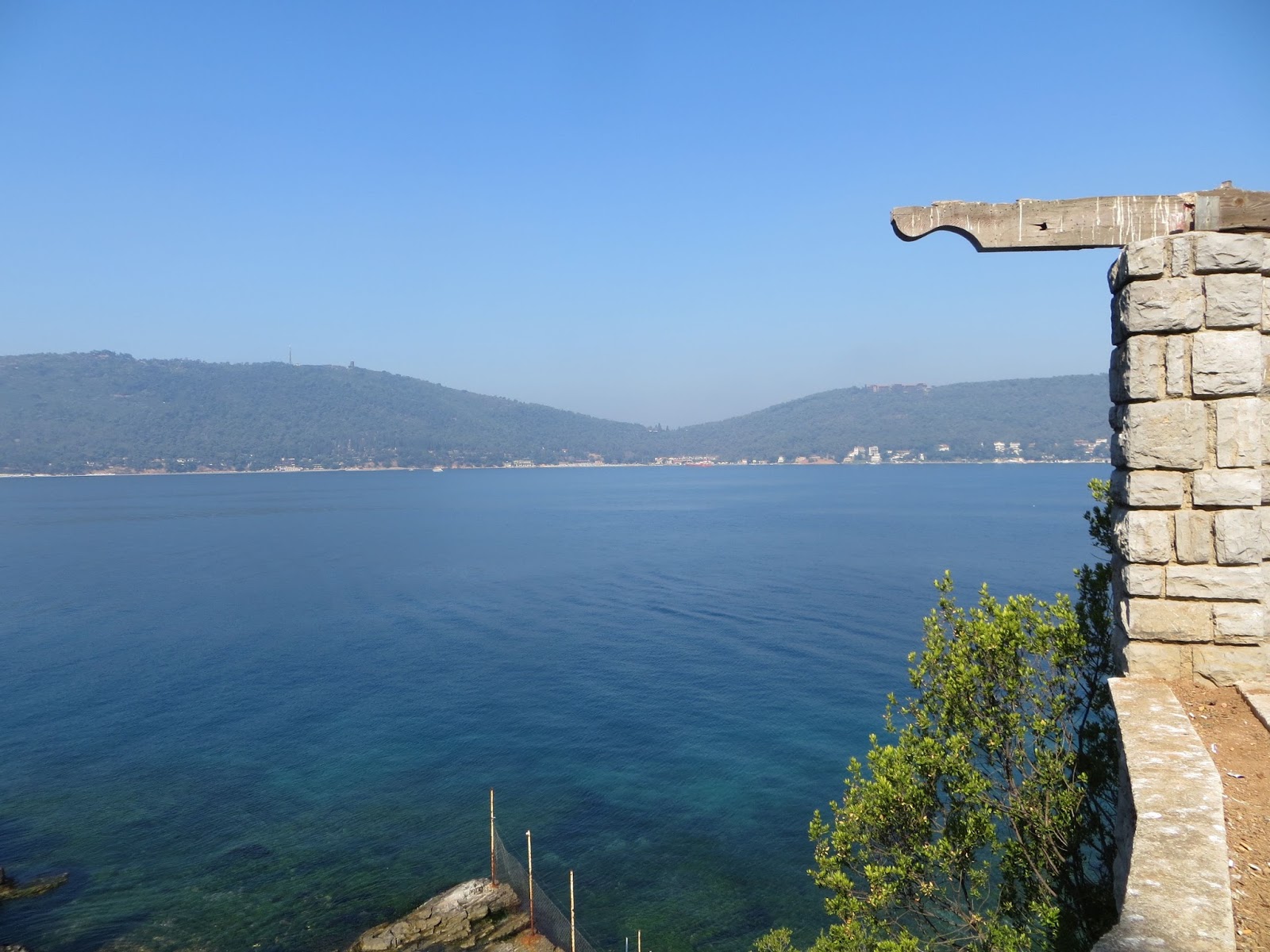
Sedef Island / Adası

 |
| Playing by the water's edge |
Anyways, there's not a whole lot to do on the island as far as we could tell, except enjoy the quietness and swim. Obviously there's food available too, and the prices are reasonable. There's not a sandy beach, but the place that's there really is enjoyable even if you have to climb over rocks in the water. All in all, this was a very enjoyable and very pretty discovery, and we will hope to visit it again in the future.
 |
| Beauty (again looking towards Büyük Ada) |
21 August 2015
Motivations in Education
I commented a while back that I had a lot of potential things to share from my time in Gambia. Here I want to summarize some of the key thoughts that various teachers shared, either those on our EDGE Institute team or summit attendees.
'We need to produce students of whom we can be proud.' A Gambian teacher-sage shared this with the group. It's a penetrating thought - will I be happy for my students to go about for the rest of their life saying, 'He was our teacher'? I should be seeking to produce students whom I will have no regrets claiming later in life, particularly in my subject area.
'Shepherding the future' as a description of teaching was new for me, although it is not actually new. I am to seek to guide and strengthen a better future through the time that I have with each student.
Both of these previous thoughts relate to something which Aristotle apparently recounted, "...Plato says, man needs to be so trained from his youth up as to find pleasure and pain in the right objects. This is what sound education means."
Maybe the most insightful thought that was brought up was the question of whether we (as teachers, as well as the society at large) are creating Thought-Consumers or Thought-Producers. In other words, do we seek to build or enhance the pool of knowledge around us, or do we simply use the thoughts that others, whether nations or individuals, pass on to us? How can a society or civilization* that does not produce original thought ever truly grow great? Sure, it can get better, but it will likely tend to be trapped by its own laziness or inability to pursue what it has into new and harder places. Since thinking is hard work, thinking new and original thoughts ought to be a key ingredient for the strengthening of any culture's mind and heart.
* I am definitely speaking of civilizations, not nations incidentally.
* I am definitely speaking of civilizations, not nations incidentally.
09 August 2015
Spurgeon, on prayer for our Children
He alone who has faith will pray for the redemption of his children, especially when they exhibit no signs of being in bondage but are hopeful and amiable.
Spurgeon, 'Jacob Worshipping on His Staff,' http://www.spurgeongems.org/vols22-24/chs1401.pdf
This goes along with another helpful resource I was reminded of this week on praying for our children, "How we pray for our children" by JD Crowley.
30 July 2015
Turkey Unveiled - a history
I just finished reading Nicole and Hugh Pope's Turkey Unveiled; and as a history of republican Turkey it is quite informative. Not only is the book very readable, it has about it a sense of Turkey and Turkish thought, including using key Turkish words to highlight important cultural values. One of the beauties of the book is that it expresses a deep understanding of Turkish culture that is understandable to those from a Western culture at the same. A sample quote:
...Turkey is in a category all its own. One reason for the West's difficulty in coming to grips with the country is that Turkey was never colonized and has never truly shared its history with one of the great European cultures.
20 July 2015
a Summary of Christian Divinity - my most recent project, finished
This evening I completed a project that I have been working on for some time, editing a 250-year old Russian Orthodox systematic theology. It's now available on Amazon. I've been working on this in my spare time over quite a few months. Several factors joined together to push me towards this little project. First, I enjoy learning through editing - I've done this for 3 or 4 other books, though I've only put two of the others on Amazon's publishing platforms. This method allows me to get to know a book well. Second, I have been seeking to learn more about the Christian tradition (Orthodoxy) in the East since shortly over the last 2-3 years; I knew incredibly little about it before that. Third, I have wondered if a theological system crafted in cultures more inclined towards an honor-shame paradigm would differ substantially from the legal/justification bent of Western theological thought.
The answer to this final question seems to be that, yes, Orthodox theology makes greater use of biblical honor-shame themes than its Western counterparts, but it doesn't neglect the legal themes. For examples, 'Mediator' is used more often than 'Redeemer' when speaking of Christ (13 times to 6), yet 'reconciliation' is used somewhat less often than 'justification' in the text.

"The love and mercy of God to all his creatures, but particularly to man, is greater than we are capable of comprehending."
"For though we ought, by all means, to do good works; yet at the same time we are to place our hope of salvation alone on the mercy of the Savior."
"He showed in what the real happiness of man consists; and this he placed in poverty of spirit, in tears and humility, in meekness and mercy, amid persecution and reviling, which was altogether contrary to the wisdom of this world."
"The worship of God is the testifying of our internal subjection of spirit before God."
After a discussion of the ten commandments:
"Notwithstanding, though we should make even so great advances in fulfilling the commandments of the Lord and whatever degree of progress we may make in virtue, yet, when we consider that all this is the fruit of divine grace and that all our virtues are mixed with imperfections, we have not the least cause of self-exaltation, but rather to keep in continual remembrance the words of the gospel, "When ye have done all those things which are commanded you, say, We are unprofitable servants; we have done that which was our duty to do."
"However, some will perhaps say, what, are we then to fall into despair? Certainly, if you continue to look up to yourselves for help. But when we reflect on the inexhaustible goodness of God and on his infinite wisdom, then we are comforted by hope, and our fears are dispelled; and in this hope we ought frequently to join in the words of Isaiah, 'Except the Lord of hosts had left unto us a very small remnant, we should have been as Sodom, and we should have been like unto Gomorrah.'"
By the way, I'd be happy to send you a pdf of the book if you would like it.
13 July 2015
humor from the young
'If math were food, I would never eat.' - a student
"There's not many things to forget about you." - a daughter, speaking to someone in an imaginary world [Is this an insult or a compliment?]
07 July 2015
The evil silent ones, like 'sword'
As I have taught English, and as I have watched my daughter try to learn to read English, I have become aware again of the ridiculousness of evil - and nearly omnipresent - silent letters lurking surreptitiously in the undergrowth of English orthography. I say 'again' because I am quite sure that I was very aware of these entrapping oddities years ago as I tried to aquire the art form called reading.
I do not say that these letters have no purpose for certainly with sufficient instruction the English spelling system can be learned. Indeed, in the case of vowels often the silent letters can give clear meaning. For instance, plumber could become plumer, but then it would be pronounced differently - so, it would need to be plummer. So, some silent letters can make sense, but there are the other, too...
So, in solidarity with those seeking to decipher the sinister silent-letter riddles, I submit these repeat offenders and request the improvement of the English language through the abandoning of this ridiculousness.
half
know
clothes
gnat
built
sword
answer
castle
comb
hour
subtle
debt
bee
plumber
island
four
caught
vineyard
could
psychology
Often more usefully, these may also be silent:
any vowel
doubled letters
Subscribe to:
Posts (Atom)