...observations and ramblings from a learner and traveler...

29 August 2019

Rhodes: a library, a castle, a church, a mosque, and the view

  I am hoping to post pictures from each of the places we visited on our trip, but it ought to be clear that we saw about 5 different locations for a couple hours over the course of 3 days. So, these pictures are by no means systematic. Mostly I just think people may enjoy having a picture of sites that they could read about in the Bible. The island of Rhodes is mentioned in Acts 21:1 where it is a brief stop on Paul's return to Syria after which he went to Jerusalem.

Church of the Virgin of the Burgh (14th century) - It has a weird history including having a road run through it. 

I find this style of mosque fascinating, but I've never actually been inside one. This one didn't have a public entrance that I could find; it may be closed.  


a Library founded by an Ottoman official a couple hundred years ago. Below are more details.
On the left, is the founding document for the Hafiz Ahmed Ağa Library. Surrounding it are translations into various languages. On the right, is a bit more history of the man and his times. 


I wish I could read the Ottoman (Arabic) script... maybe someday! The language is just an older version of Turkish, so the major hinderance is the orthography, as well as the changes that have occurred in Turkish vocabulary.

Library books, old and new
The view from the Clock Tower: notice the modern city beyond the old city walls
180-degree view from the clock tower

View of the castle from the tower 
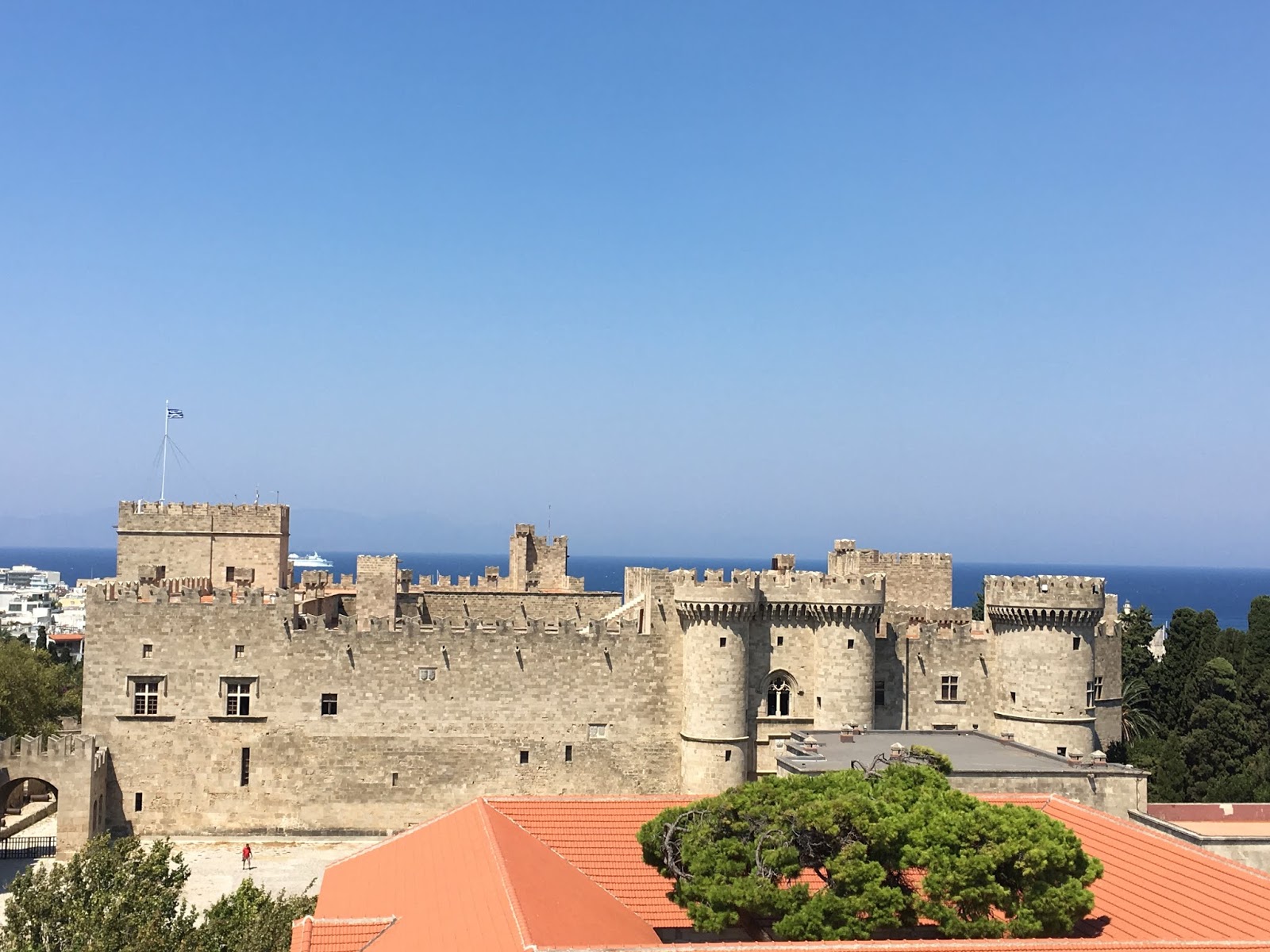
 Apparently this is technically known at "The Palace of the Grand Master of the Knights of Rhodes." Impressive, but I only saw the outside. 


26 August 2019

Patmos - the island

  Shortly after we got married, Bethany told me that we needed to start saving so that we could "do something special" for our 10th anniversary.  Since we were barely making ends meet at the time, this seemed like an odd thing to save money for, to me.  However, she was certainly right, and we started it with a few dollars. Last week, a decade of saving came together, and we got to go on a cruise in the (nearby) Greek islands! We flew to Izmir and got on the ship, and a few hours later, we were at our first stop, the island of Patmos. 

The harbor at Patmos
  My recollection of how Patmos is described in biblical commentaries on the book of Revelation is "a small rocky island"... not that I could give a specific reference for that. That description is not particularly wrong, although the island is quite a bit bigger than I envisioned. It's small for an island, but it's not particularly small.

Harbor picture 2
  There was a tour that showed various historical (or supposedly historical?) sites on the island, but we preferred to just walk around the town and observe it from various perspectives. We also enjoyed some excellent ice cream there and bought some pistachio-chocolate sauce (imagine dark chocolate Nutella, made with pistachios!)


The town on Patmos

Sunset over Patmos harbor

the sun disappearing


15 August 2019

The Museum that Shocked Me

The first time I visited Turkey, my host dropped me off at the Museum of Anatolian Civilizations. I love history, and I was shocked to discover empires that I had never heard of. I've always wanted to go back with a little more knowledge. This summer I got to go with my family (using the high-speed train)... I got to expose the kids to empires that had come and gone before the time of Abraham. Amazing! Below is a slightly blurred picture of one of my daughters observing a replica of an ancient Hittite monument depicting their gods and lions. I hope her world expanded!

13th Century Hittite monumental steele (replica; original in Konya province)

Artifacts believed to be from the 6th millenium BC

Stone knives can sound relatively harmless till you see them!
dated 6th millenia BC

Seals or stamps from the same timeframe

Check out the block of obsidian for chipping knives off of! 


a Hittite "holy cow"

 Remember King Josiah?
A steele from Carchemish, dated 900-700BC.
See the inscription below.


There is a ton more to see, but these were some of my favorites from a few sample empires.


28 July 2019

Is All Sin the Same? or Are Some Sins Worse than Others?

Is there Greater and Lesser Sin?

  Over the years, I have periodically posted theological musings that are rather speculative. When I do so, I try to label them as such. I distinctly remember John Hartog's guest lecture in my sophomore class on Romans in which he discussed Abraham, his faith, and eschatology while being clear that some of his ideas were speculative. This made the lesson quite interesting; and as I recall, his basic speculation was whether Abraham would be physically raised to walk on this earth given the promises that God would give him the land. This post should not be that speculative, but it is certainly more a musing than a statement.

 You may have heard someone say, "All sin is equally bad"; you might have even said it yourself. But is it true according to the Bible?

 Here are some initial Scriptures to consider: Leviticus 4:2, 13, 22, 27; 5:15-18; Numbers 15:22-31; Proverbs 21:27; Ezekiel 8:6, 13, 15; John 19:11. Click this link to read the verses. Spread throughout the Scriptures in the Law, the Writings, the Prophets, and the Gospels, these passages certainly seem to suggest that some sins are more serious or worse or greater in some way than others. A leadership role (cf. James 3:1), motivation, and amount of knowledge seem significant in God's weighting of sins. For instance, consider what Numbers 15 shows below:


 From these passages, it seems clear that not all sins are the same. Still, someone might object that while all sins are not the same, they all still deserve the same judgment due to God's just wrath. Certainly, all sin dishonors the Creator God of the universe, separate us from Him, and can justly be punished by Him. However, the Bible does not seem to portray all sin as deserving the same degree (?) of judgment. Lamentations 4:6; Matthew 11:20-24; Mark 12:38-41; Luke 20:45-47; Hebrews 10:26-29; James 3:1 (link), as well as the details of the Mosaic sacrificial system, point to varying levels of judgment as being appropriate to varying sins. I do not mean to suggest that God is not angry at some sins; instead, I think it might be appropriate to say that some sins are more grossly and deeply offensive than others.

  This suggests the question whether all sinners are equally evil and equally deserving of judgment. That is a very different question, which I don't intend to go into in detail. However, I think the simple answer is that rejecting God's revelation in nature, Scripture, and/or His people and preferring our own way is the root sin of all sinners. Thus, we are all equally sinners separated from God whether the weight of our individual sins and their respective appropriate judgments are equal or not. 

  In summary, we must realize that God does not necessarily evaluate sins in the (constantly shifting) way that human cultures do. Ingratitude is a major sin in Scripture (Numbers 21; 2 Timothy 3:2), as is disobedience to parents. Thus, a Scripturally-tuned conscience and set of evaluations is needed for these topics. At the same time, all sin, no matter how small or large, is abhorrent to the holy God and should be as abhorrent to us. 

 Do you have any thoughts or additional texts to mention?

Additional texts to consider:
~ Romans 1:18-32 begins with God's wrath against ALL ungodliness and then describes some of the different developments and aspects of sin.
~ Luke 7:36-50 seems to suggest something about both quantity and weight of sin committed by different individuals in both the parable and the subsequent comments by Jesus.
~ Matthew 23:23 seems to suggest that some good actions are more significant than others. We can wrongly evaluate positive things we do as well.
~ Matthew 12:31 - the unforgivable sin against the Holy Spirit
~ 1 John 5:16-17 - the sin that leads to death 
~ Matthew 5:17-22
~ John 15:22-24
~ 1 Corinthians 14:20 - be infants, not mature in evil.

24 July 2019

The Necessity of a Practical Ecclesiology

 The other day, a mentor commented to me again on the practical importance of a strong theology of the church and its workings, good ecclesiology. When Christians do not have a strong, practical ecclesiology, we are more likely to act in ways that disagree with the spirit of the Scriptures. I am not referring to breaking explicit "rules" of Scripture, but to the fact that we may fail to fulfill our roles as integral and integrated parts of the body of Christ. Thus, there could be a failure to care for a sister or brother in need, to submit to the (church) body or its leaders, to value troublesome and supportive members equally, to provide for those who minister the Word, etc. These problems could be supplemented with a list of difficulties that a weak theology of the church can impose on the structuring of the church, such as choosing proper leadership and removing those who are persisting in behaving in ways that disagree with Scripture.

  As I was reading 1 Corinthians 12 in the last couple days, I was struck by one of these practical aspects of ecclesiology:


  Shepherds of churches may see a requirement here to spend more time and energy on those people who seem 'less lovable', but the point in 1 Corinthians seems much wider. This is BODY work. The whole body of Christ, everyone in a church, should be united in intimate concern with the health and progress and honor and needs of every other member or organ. (As I've shared before, the word "member" here has more of the modern idea of "body parts" or "limbs and organs.") Anthony Thiselton (2006) comments, "So-called unpresentable parts play an even more indispensable role in sustaining the life of the body than, for example, an eye or an ear, which on the surface may appear more important." While a body can live without an eye, living without an intestine or stomach - as unpresentable as those may be - is obviously far more problematic. The "unpresentable" parts are "indispensable," and if there were not such differences - gross and under-appreciated though some of them may be, there would be no body. Many indispensable and honorable parts must always be contributing to the "common good" of one body.

 In the context of 1 Corinthians 12, the Holy Spirit and Paul apply this truth by warning the Corinthian believers not to see certain members as having "lesser gifts." There are no second-class followers of Christ! The Spirit has carefully distributed the gifts to the church in such a way that honor and responsibility will be given to all. This, of course, has practical implications for how each one of Christ's living body parts should behave and feel toward each other part. Two more quotes from Thiselton and one from MacLaren's Expositions expose some practical implications of this:

Thornton observes, "In the Body of Christ there are, strictly speaking, no private sufferings. All are shared because there is one life of the whole. Accordingly wrong done to one member is wrong done to the whole Church, and therefore to Christ himself" (Common Life, p. 36). This principle also demands the utmost sympathy and sensitivity between fellow Christians, to share in the joys and sorrows of each. 
========== 
How often do we use this model (as Paul does) to stress that the vulnerable and less favored need the support and service of the strong? 
========== 
For every one of us has something, and no one of us has everything; so, on the one hand, we want each other, and, on the other hand, we are responsible for the use of what we have. (MacLaren)

 In applying this to ourselves, I have two questions for you: How many body parts do you have as a human? Do you keep a list of them? I imagine that you don't know and that you don't have one. Me neither. We don't usually make lists of the things closest to us; but, we recognize our body parts when we see and feel them. In the same way, we should recognize those who are part of the body of Christ which we are part of. Don't simply look to a list of people as the organs and limbs of Christ in your local church: who is there, how are they functioning, how can you support them? You may not know their exact function or gifting, but value and honor them as those whom Christ and the Spirit have valued and honored. Remember they may well be more indispensable than you or I.

~ Expositions of Holy Scripture: Romans Corinthians (To II Corinthians, Chap. V) (Maclaren, Alexander)
~ 1 Corinthians: A Shorter Exegetical and Pastoral Commentary (Anthony C. Thiselton)

30 June 2019

Brene Brown regarding Teachers and Their Role

But what we can do, and what we are ethically called to do as teachers, is create a space in our schools and classrooms where all students can walk in and, for that day or hour, take off the crushing weight of their armor, hang it on a rack, and open their heart to truly being seen.

Teachers are the guardians of spaces that allow students to breathe and be curious and explore the world and be who they are without suffocation. Students deserve one place where they can rumble with vulnerability and their hearts can exhale.

~ Brene Brown, "Teachers: Our Most Daring Leaders" (emphasis mine)

06 June 2019

How many prophetesses are there in Scripture?

 A while back in my office - it was probably around International Women's Day, the discussion arose about prophetesses and whether the Bible recorded any. The colleague I was talking to is a well-informed Muslim although she's not specifically trained in theology. She didn't remember any being mentioned in the Kuran although she thought it was reasonable to assume that some of the thousands of prophetic messengers that are referenced in the Kuran were women.

  It seems likely to me that if one accepts both the speaking 'messenger' and speaking-writing 'prophet' within Islam as "prophets," it's quite likely that Eve, Mary the mother of Jesus, and other women could be considered prophets according to Islam. However, an internet search quickly shows that this is a disputed opinion, and it is certainly not one that I have the expertise to speak about.

  Anyways, for the student of the Torah, Psalms, Prophetic and Gospel writings, it is certainly clear that there were prophetesses. In fact, they are listed throughout Scripture. So, a pop quiz:

How many prophetesses are named in the Bible? Who are they?

  Who is the one in the Torah? Who are the two in the historical writings? Who is the one in the prophetic writings? Who is the one in the Gospel writings about Jesus? Who are the ones in the earliest church?

  Miriam, the sister of Aaron and Moses - Exodus 15:20 - It is not mentioned whether she married or not in the Scripture themselves. Some tradition suggests she was.
  Deborah - Judges 4-5 - Her husband is mentioned, but children are not.
  Huldah - 2 Kings 22:14; 2 Chronicles 34:22 - Her husband is mentioned though children are not.
  _?????_, unnamed wife of Isaiah - Isaiah 8:3 - Her husband was also a prophet; she had at least two sons. (Some suggest she may simply be being referred to as "the prophet's wife" in this passage, but many argue against this.)
  Anna - Luke 2:36 - She had been married, but had been widowed for a long time when she sees Jesus and is mentioned as a prophetess. (related post on "The Odd Notion of 400 Silence Years")
  The 4 Daughters of Philip - Acts 21:9 - These daughters are specifically mentioned as being unmarried at the time when they met Paul and Luke.

  Each of these prophetesses, as well as the additional women and passages below, could be considered in a lot more detail in order to develop a thorough understanding of this area. The people and priests and kings of Israel would all come to these prophetesses to consult them about the word of the LORD. Personally, I wanted to have a clear answer to the question, but the answer will always depend on the phrasing of the questions. How many prophetesses of the Lord are NAMED in Scripture? 4 along with others who like many prophets in Israel remained unnamed. How many prophetesses of the Lord are mentioned in Scripture? 8. 

Additional tidbits and relevant Scriptures:
  Joel 2:28-29; Acts 2:17-18 [cf 1:15; 2:1-4]; 1 Corinthians 11:5

  Two women are mentioned as false prophetesses as well, Noadiah (Nehemiah 6:14) and Jezebel (Revelation 2:20). In the second case, the name might be figurative.

  The Jewish Talmud (rabbis' discussions of the Scriptures) lists seven Jewish prophetesses: Sarah, Miriam, Deborah, Hannah, Abigail, Huldah, and Esther. (Megillah 14a) It is also gives the reasons each is considered a prophetess. It is interesting that the Talmud does not include Isaiah's wife.

15 May 2019

Reading's Purpose and Speeds

  I set out to read a sample of this book, How to Read a Book, so that I could take it off my list. It comes highly recommended, but I thought I probably don't need to read it any more. Turns out, maybe I do. Initial thoughts...

"To achieve all the purposes of reading, the desideratum [requirement] must be the ability to read different things at different -appropriate- speeds, not everything at the greatest possible speed. As Pascal observed three hundred years ago, "When we read too fast or too slowly, we understand nothing." 
~ Mortimer Adler, How to Read a Book, Preface

23 April 2019

A Turkish Shepherd Calling His Own Sheep (and someone else's!)

  About a month ago, one of the most interesting videos I've seen came into the news here in Turkey (news article about it). It had been preceded 8 years earlier by the first video which is below. I have transcribed and translated what I thought were the most interesting parts of both videos (except for the shepherd's call itself, which didn't seem to need translation).  


First video: The Shepherd Calls Another Shepherd's Sheep (Youtube)
The interviewer from TRT news channel is welcomed by a shepherd, İlhan Orak. He asks his occupation and how long he has been shepherding, 40-50 years, since he was a child.

The interviewer says (0:33), “And your sheep are here.” The shepherd responds, “These aren’t mine. They are a friend’s. Mine are way down there.”

Interviewer (0:38):
The sheep, if you called them, they’d come?
Shepherd (0:40): If we went over there – they’d come right away!
Interviewer (0:42): Then, let’s call these.
Shepherd (0:43): These won’t come.
Interviewer (0:45): Why wouldn’t they come?
Shepherd (0:46): These don’t know me. Mine know me.
Interviewer (0:48): You’ve been a shepherd for 50 years…!
Shepherd (0:49): Mine know me!
Interviewer (0:51): Let’s try and see if they’ll come?


The shepherd demonstrates how he calls his sheep. 

The presenter laughs, “There’s no movement among the sheep. They didn’t even blink.” The shepherd responds, “Vallahi, they aren’t mine! They didn’t look.” Then, the presenter asks whether the shepherd’s own sheep would have come if he’d called them. The answer is yes, if they went over that way. The presenter asks how the shepherd reaches an understanding with the animals. Finally, they begin discussing the shepherd himself.


Second Video: The Shepherd Calls His Own Sheep (Youtube)
In the second video, the same interviewer visits the shepherd again, 8 years later. The shepherd says (0:37), “I’m 63 years old now, and the TRT interviewer came before. Those weren’t my sheep. They didn’t know me. Mine know me." 

The interviewer asks (0:45), If we call yours, will they come?
Shepherd (0:47): Now? ... (calls)
Shepherd (1:05): Look how they are coming. Do you know it? … Last time, those weren’t mine. See, these are actually mine. They know me.

Watch it happen!


  The shepherd is not expressing this out of knowledge of Jesus' words in the gospel of John: in the later parts of the second video, he expresses his Islamic faith. But for those of us who have not grown up around sheep or shepherds, this is a really beautiful way to understand the words of Jesus more deeply. (Incidentally, the shepherd, like most believers in Islam, would probably say that he believed in the gospels, the İncil. Thus, I trust that he would not be bothered by my making this connection.)

But he who enters by the door is the shepherd of the sheep. To him the gatekeeper opens. The sheep hear his voice, and he calls his own sheep by name and leads them out. When he has brought out all his own, he goes before them, and the sheep follow him, for they know his voice.

I am the good shepherd. I know my own and my own know me, just as the Father knows me and I know the Father; and I lay down my life for the sheep. And I have other sheep that are not of this fold. I must bring them also, and they will listen to my voice. So there will be one flock, one shepherd.


My sheep hear my voice, and I know them, and they follow me. 
(ESV)

18 April 2019

Key Resources on Academic Writing - Canagarajah and Hinkel

  In over 13 years of blogging, the 3+ months since my last post is the longest I have ever gone without a post. Then again, I've never written a master's thesis before. Since the final version of my thesis got submitted last night, I can now begin sharing some of my thoughts here again.

  My thesis was on academic writing, and I developed a curriculum and the accompanying materials for a course that can take learners from the earliest stages of learning English writing up to being ready to start university in English. My studies ranged all over, but two books proved particularly critical to my understanding and expression of academic writing - Eli Hinkel's Effective Curriculum for Teaching L2 Writing and Suresh Canagarajah's Critical Academic Writing for Multilingual Students. Neither of them sounds like much fun, but they are both fantastic - if you are interested in academic writing!


 Hinkel has written a number of other books, but Effective Curriculum is a masterpiece. It is packed with the practical resources that any English academic writing teacher can use, but especially those who teach English as an additional language for the learners. Not only does she show the research behind her assertions, Hinkel also supplies the details that are needed to implement it. As a minute example, we learn not only about the importance of the passive voice in academic writing, but we are also given the particular passive verbs that are most commonly used. This is an extraordinary resource!


 Canagarajah, on the other hand, designed a masterpiece on how to think about academic writing. Critical Academic Writing provides a philosophy of teaching and of writing that is mindful of the competing needs of respecting and preserving cultural diversity and individuality while also integrating learners into academic conventions to give them maximum opportunities for success. Again, extraordinary!